

Almost every marketing team uses AI somewhere in the content process now. Drafts show up in minutes, outlines appear on request, and a month of captions doesn’t eat a whole week anymore. That speed is genuinely useful. But there’s a catch: much of today’s AI content marketing sounds the same, says nothing new, and slowly chips away at the trust a brand took years to build.
You don’t have to give up AI to fix this. You just need one habit, the human edit rule: nothing goes live until a real person has checked it, shaped it and approved it. Here’s how to make that work without slowing everyone down.
What Is the Human Edit Rule?
Simply put, AI can start the work, but a human finishes it. Treat AI like a quick junior assistant. It can gather material and write a rough draft, but it doesn’t know your customers, your pricing, your local market, or the promise your sales team made last week.
And a human edit is more than fixing typos. Someone checks the facts, adds first-hand experience, rewrites the stiff lines in your brand’s own tone, and asks the honest question: would a reader actually find this useful?
Why Google’s Latest Guidance Makes This Rule Hard to Ignore
Google has long said it cares about quality, not the tool that produced the content. Still, on 1 October 2026 it updated its guidance on using generative AI content to say that AI-generated content should be manually fact-checked and reviewed for accuracy and trustworthiness before publishing. That review also covers metadata, such as title tags, meta descriptions, structured data and image alt text.
The same page warns that publishing lots of pages without adding value for users can break Google’s spam policy on scaled content abuse. That’s the pattern the policy is aimed at, and our breakdown of Google’s September 2026 spam update explains what to check on your own site.
Google’s people-first content guidelines also give you a simple test: ask who created the content, how, and why. The human edit rule is what lets you answer all three honestly.
Where AI Helps and Where Humans Must Step In
Not every task needs the same level of oversight. A quick split saves a lot of debate.
Good Jobs for AI
- Summarising long research papers and documents
- Building outlines and content briefs
- Drafting routine copy like product descriptions
- Turning one idea into several formats
- Suggesting headline and caption options
Jobs That Need a Human
- Verifying statistics, dates and claims
- Adding real examples, client lessons and opinions
- Local context, like Kerala or UAE audiences and language nuances
- Anything touching pricing, legal, medical or financial claims
- Final tone and brand voice
Build a Prompt Library Instead of Starting From Scratch
If everyone on the team types a fresh prompt each time, the output will never feel consistent. A prompt library solves that. It’s a shared document of tested prompts for recurring tasks, with the right context already built in.
A good prompt covers five things: audience, goal, brand tone, format, and what to avoid. Instead of “write an Instagram caption,” a library prompt says who the caption is for, which words your brand never uses, how long it should be, and what action you want. Teams that plan social content month after month, as we cover in our social media marketing guide, gain the most here.
A Five-Step Human Edit Checklist
Use this on everything, from a blog post to a WhatsApp broadcast.
- Fact-check. Confirm every number, date and claim against a primary source. If you can’t verify it, cut it.
- Add experience. Put in one real example, client observation or lesson that only your team could write.
- Fix the voice. Read it aloud. If it sounds like any other brand, rewrite the opening and closing lines yourself.
- Cut the filler. Remove vague phrases, repeated points and sentences that sound polished but say nothing.
- Check search readiness. Review the title, meta description, headings and alt text, and make sure the page answers the question clearly enough to be quoted. Our guide on checking whether your business shows up in AI search answers shows how to test this.
Here’s what that looks like in practice. An AI draft might open with, “In today’s fast-paced digital world, businesses must adapt.” An editor swaps it for something specific, like a question a client really asked last week. The facts barely change, yet readers can tell someone who knows the subject wrote it.
How Much Editing Does Each Content Type Need?
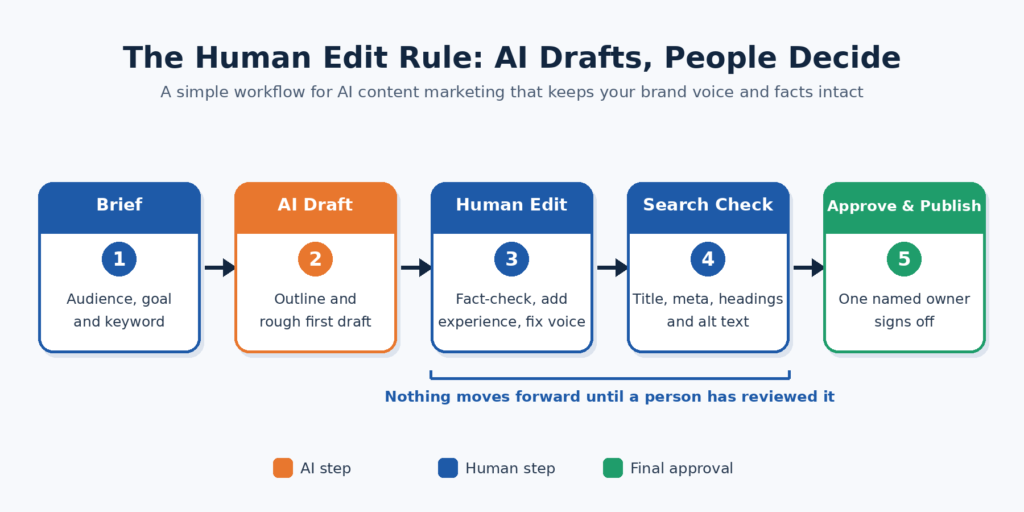
Not every piece needs the same depth of review. A casual social caption carries far less risk than a blog post full of statistics, and ad copy sits somewhere harder still, because one unsupported claim can cause policy trouble. A simple rule helps: the higher the risk to trust, money or health, the deeper the human review should go.
Anything involving legal, medical or financial advice should be checked by a qualified expert, not just an editor. For everything else, match the effort to the risk.
What a Human-Edited Workflow Looks Like
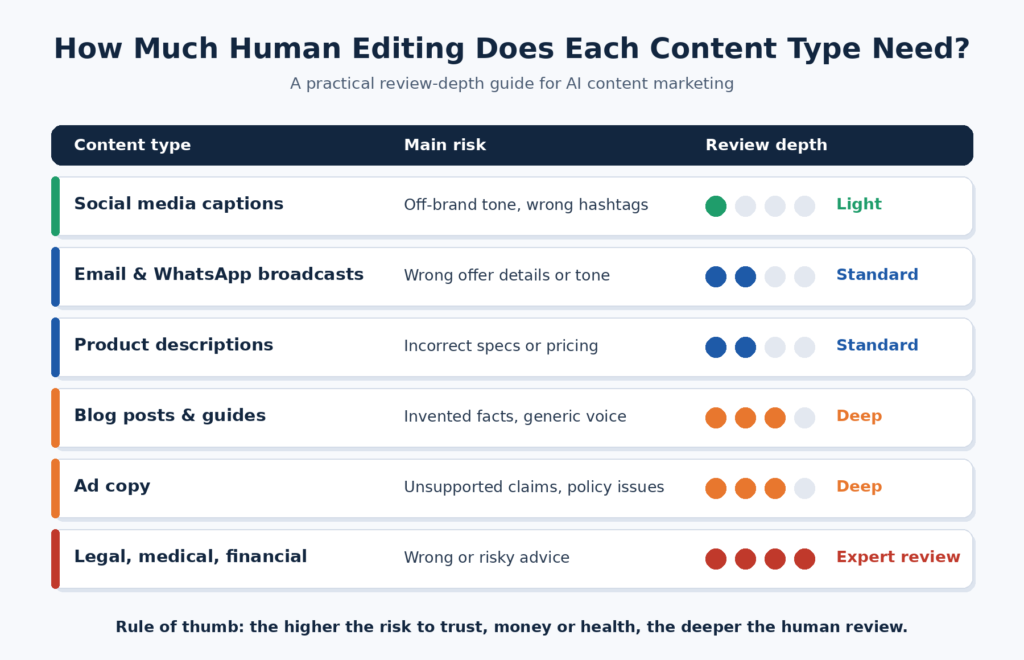
Start with a short brief naming the audience, the goal and the keyword. Let AI produce the outline and a rough draft, then pass it to an editor who checks facts, adds real examples and rewrites the voice. Only after that read-through does the piece go to scheduling or publishing.
What matters most is that one named person owns the final version. When responsibility is shared between “the tool” and “the team”, mistakes slip through. This checkpoint matters even more as tools begin acting on their own, a shift we explain in our post on agentic AI in digital marketing.
Frequently Asked Questions
Will Google penalise AI-generated content?
Google says it looks at quality rather than how content is produced. Low-value pages made at scale, though, can break its spam policies, so editing is your protection, not a formality.
Should we tell readers we use AI?
Google’s people-first guidance asks about the “how” behind your content, so a short note on your process is a sensible choice wherever readers would expect one.
Do titles and meta descriptions need fact-checking too?
Yes. Google’s updated guidance says the manual review also applies to metadata, including title tags, meta descriptions, structured data and image alt text.
How do I keep a consistent brand voice when using AI?
Build a prompt library with your tone and the words you avoid, add examples of approved copy, then read every draft aloud. If it doesn’t sound like your team, rewrite it.
Can AI replace a content writer or editor?
Not really. AI brings speed and structure, but not first-hand experience, local knowledge or accountability for what’s published.
The Takeaway: Let AI Draft, Let People Decide
AI gives you a head start, but trust comes from the human work that follows. Build a prompt library, run the five-step checklist, and keep a real person accountable for every published word. Do that, and your AI content marketing will move faster without sounding like everyone else’s.