

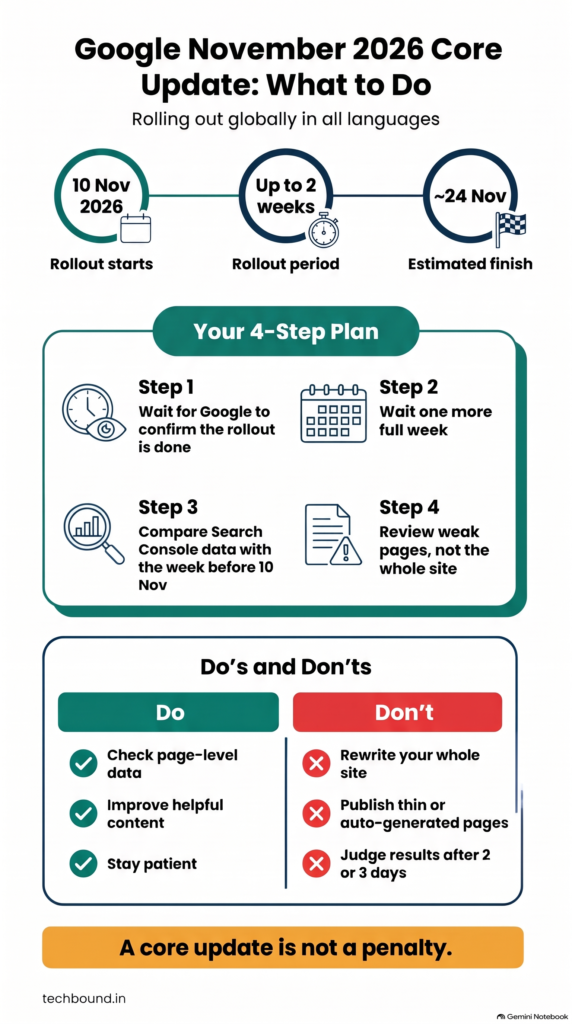
Google began rolling out the November 2026 Core Update on 10 November, and it applies globally to all languages. Google says it can take up to two weeks, so the full picture should settle around 24 November. If your rankings are bouncing, don’t rewrite your site yet. Wait for the rollout to end, then compare your Search Console data with the week before 10 November.
If you opened Search Console this morning and your graph looked like a heart monitor, welcome to the club.
We refresh our dashboards just as often during a core update, honestly. But experience has taught us one thing: the first few days say very little. So let’s go through what’s actually confirmed, what isn’t, and how to respond without making things worse.
What Is the Google November 2026 Core Update?
A core update is a broad change to the systems Google uses to rank pages. It doesn’t go after one site, one niche or one mistake.
According to Search Engine Journal’s report on the rollout, here’s what Google has confirmed:
- The rollout started on 10 November 2026.
- It applies globally and to all languages.
- It may take up to two weeks to complete.
- It’s the third core update of 2026.
Notice what’s missing? Google hasn’t said what this update focuses on. So anyone claiming to know exactly what it “targets” is guessing, and we’d rather tell you that than sell you a theory.
When Will the Rollout Finish?
Two weeks from 10 November lands on roughly 24 November. That’s an estimate, not a promise. Google says it will update its ranking release history page once the rollout is done.
For some context, the earlier 2026 updates looked like this:
| Core Update | Started | Finished |
|---|---|---|
| March 2026 | 27 March | 8 April |
| May 2026 | 21 May | 2 June |
| November 2026 | 10 November | Expected around 24 November |
Both earlier updates wrapped up in about twelve days. A handy guide, but no guarantee.
Why Are My Rankings Jumping Around?
Because a core update isn’t a single switch being flipped. Google’s John Mueller has explained that these updates touch several systems, so changes can go live in steps instead of all at once.
In practice, that’s why you might notice:
- A page climbing on Monday and sliding back by Thursday.
- One section of your site is moving while the rest sits still.
- Different positions for the same keyword in different locations.
It’s a bit like judging a cricket match after the first over. Fun to watch, useless for predicting the result.
How Do I Check Whether the Update Hit My Site?
Google’s own advice is refreshingly simple, which is why we follow it. The core updates documentation from Google Search Central suggests this routine:
- Wait until the rollout is officially complete.
- Give it one more full week.
- Pull that week’s data from Google Search Console.
- Compare it with the week before 10 November.
- Look at individual pages and queries, not just the sitewide total.
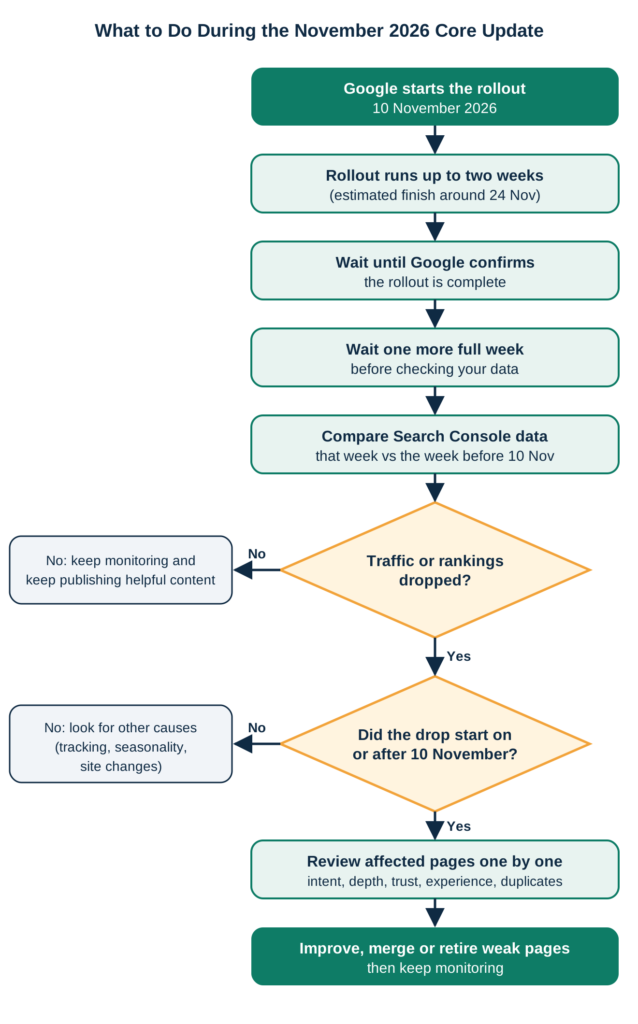
Step five is where the answers hide. A sitewide dip often comes from just two or three pages, and those are fixable. If reading the reports still feels like decoding a puzzle, our Search Console guide walks through the queries and pages views in plain language.
One more thing. Check that the drop really began on or after 10 November. If it started earlier, the cause is probably something else, like a tracking change, a seasonal dip or an edit on your own site.
What Should I Do If My Traffic Drops?
Take a breath first. A core update isn’t a penalty. Pages that fall are usually being outranked by pages Google now considers more helpful, not punished for breaking a rule.
That also means there’s no magic button. What works is an honest look at the pages that lost ground:
| Area to Review | The Question to Ask |
|---|---|
| Search intent | Does the page answer what the searcher really wanted? |
| Content depth | Does it add something original, or just repeat what’s already out there? |
| Trust signals | Is there a real author, a short bio and clear business details? |
| Page experience | Is it fast, easy to read and free of annoying pop-ups? |
| Structure | Does it give the answer early, with clear headings and short paragraphs? |
| Duplication | Are two similar pages fighting for the same keyword? |
That last row catches more sites than you’d think. Publishing three near-identical posts on one topic and then wondering why none of them ranks is a surprisingly common habit.
Does AI Search Change Any of This?
Quietly, yes. The pages Google rewards in a core update are often the same ones AI tools like to quote: clear, specific, trustworthy and easy to scan.
So a page that opens with a direct answer, shows real experience and uses neat lists or tables works twice as hard. It helps human readers, and it gives AI systems something clean to pull from. If that world is new to you, our guide to GEO and AI search visibility is a good place to start.
What Should I Avoid During the Rollout?
Some of the worst SEO decisions are made in the middle of a core update. Please skip these:
- Rewriting your whole website in a panic.
- Mass-publishing thin or auto-generated pages to “recover”.
- Buying links or pasting one article across a dozen sites.
- Judging results after two or three days.
Recovery is usually slow and sometimes only shows up after the next update. Steady improvement beats a frantic overhaul almost every time.
How Do We Handle It at Techbound?
Our routine is deliberately boring. We note a baseline before the rollout starts, hold off on big edits while it’s live, and review client data only after things calm down.
When a page turns out to be weak, we ask one blunt question: would a real customer in Kerala or the UAE actually find this useful? If the honest answer is “not really”, we rework it, merge it or retire it. Our SEO services run on the same principle, because patience tends to beat panic.
Frequently Asked Questions
How long will the Google November 2026 Core Update take?
Google says up to two weeks from 10 November 2026. That points to a finish around 24 November, but treat the date as an estimate until Google confirms it.
Is this update a penalty?
No. A core update re-evaluates content across the web. A page can slip simply because other pages are now seen as more helpful.
Will it affect websites in India and the UAE?
Yes. Google says the update applies globally and to all languages, so sites in any country can see movement.
Should I change my content right now?
Not in a rush. Let the rollout finish, wait another full week, then fix real quality gaps based on your data.
One Thing to Remember While the Update Rolls Out
Core updates feel dramatic, but they’re really just Google adjusting how it decides what’s most helpful. Your job doesn’t change: publish things that genuinely help people, keep them clear and honest, and show who’s behind them.
So for the next two weeks, watch your data without reacting to it. Make your baseline notes, fix only what’s clearly broken, and save the bigger decisions for when the numbers have settled. Sites that stay calm usually make better calls than sites that chase every wobble.
If your rankings feel unpredictable and you’d like a clear second opinion, talk to a digital marketing agency in Trivandrum that tracks these updates on real client sites.