
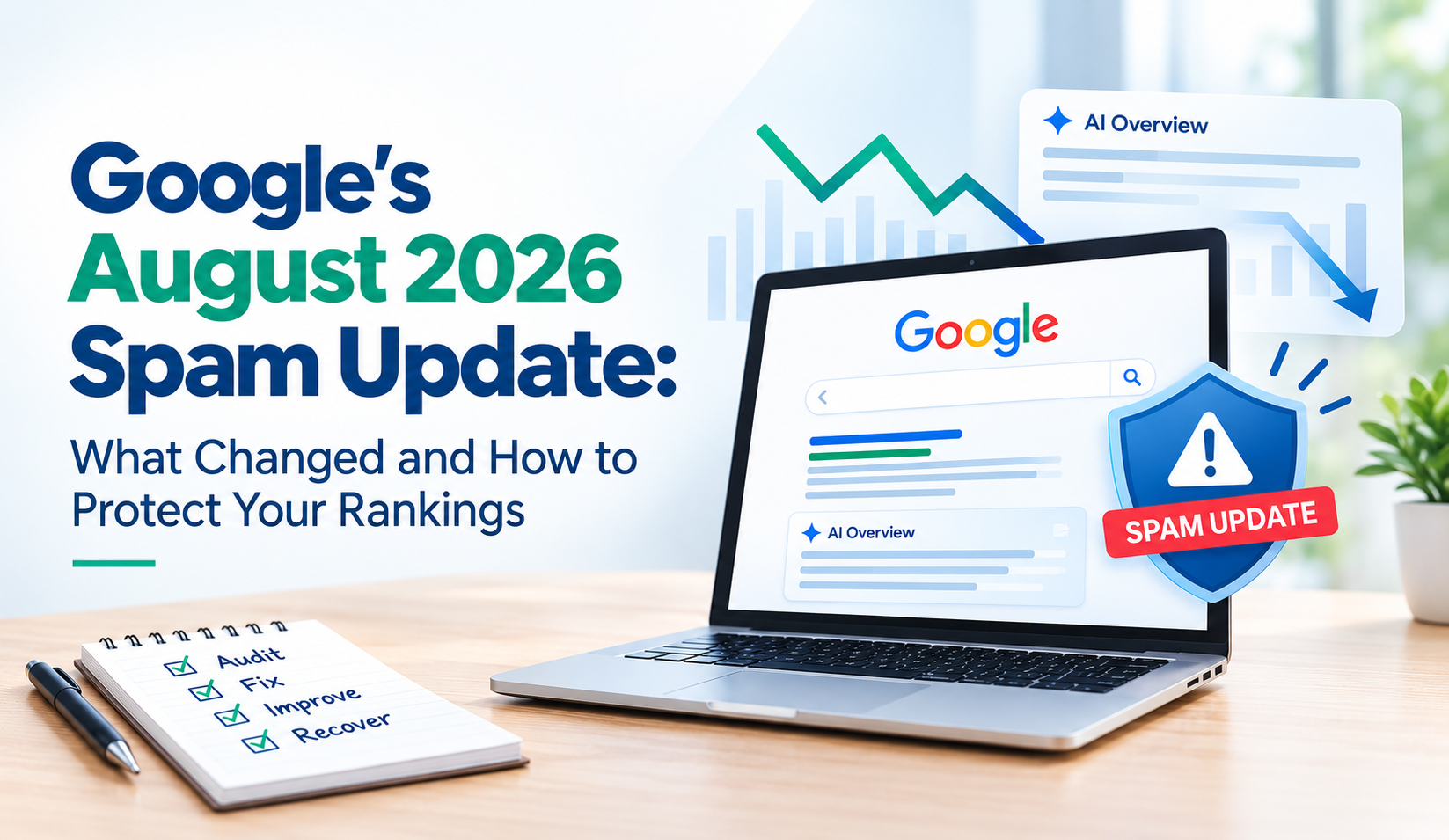
If your traffic graph took an unexpected dip between August 18 and August 21, you were not imagining things. Google rolled out its third confirmed spam update of the year during that window, and site owners across every language and region felt the aftershocks. For businesses that rely on organic search for leads, understanding what this update targeted, and what it means going forward, isn’t optional homework anymore. It’s just part of running a website in 2026.
What Was the August 2026 Spam Update
The August 2026 Spam Update is Google’s latest enforcement pass against content and practices that violate its existing spam policies. A spam update is narrower than a core update. Core updates reassess how pages are ranked overall. Spam updates target sites and pages that Google’s systems and human reviewers believe are manipulating results through low-value, automated, or deceptive tactics.
This was not Google’s first spam action of 2026, and it will not be the last. Search has always had a cat-and-mouse dynamic between search engines and people looking for shortcuts. Spam updates are how Google periodically resets the board.
Rollout Timeline and Scale
The rollout began on August 18, 2026 and finished roughly two days and sixteen hours later, on August 21. That is a fast, global deployment across all supported languages at once. It moved faster than the slower, staggered pattern Google sometimes uses for broader algorithm changes.
Industry rank trackers picked up on the disruption almost immediately. According to Search Engine Land, high-ranking URLs shifted position noticeably more often during the rollout than during a typical baseline period. That pattern is consistent with a spam action rather than routine daily fluctuation. If a client’s rankings moved sharply during that exact week with no clear on-page cause, this update is the most likely explanation.
Speed matters here too. A rollout compressed into under three days does not leave much room for a gradual, wait-and-see approach. Sites caught on the wrong side of enforcement typically saw the impact within days, not weeks. That is a shorter reaction window than webmasters have grown used to with slower core updates.
What Google Actually Targeted
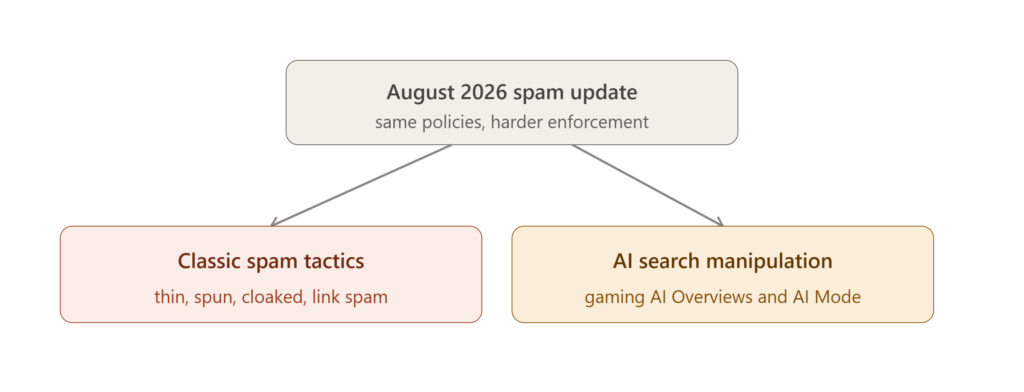
Here’s the part that matters most for planning: Google didn’t introduce brand-new spam policy categories with this update. The rules stayed the same. What changed is enforcement, and specifically, enforcement now reaches more aggressively into content designed to manipulate AI-driven search surfaces, including AI Overviews and AI Mode.
Classic Spam Tactics Still in Scope
The update went after the usual suspects. That includes thin auto-generated pages, scraped or spun content, cloaking, and link schemes. None of these tactics are new to Google’s radar, but enforcement against them clearly intensified during this rollout.
A New Enforcement Angle: AI Search Manipulation
The update also cracked down on newer tactics aimed at gaming AI-generated answers rather than traditional blue links. As AI Overviews and AI Mode have taken up more real estate in the search results, they have become a target for manipulation in their own right. Google is now treating that manipulation the same way it treats classic web spam.
Why This Matters for AI Search Visibility
This is a meaningful signal for anyone doing SEO work in 2026. AI-generated answers are pulled from content Google’s systems judge to be trustworthy and well-sourced, not just well-optimized. Content that leans on keyword density, artificial structuring, or automated generation to appear authoritative is now a spam risk in two places at once: traditional rankings and AI-driven features.
The practical takeaway is simple. Genuine expertise, clear sourcing, and original insight are doing double duty right now. They protect a site from spam enforcement, and they improve its odds of being cited inside an AI Overview. That overlap is not a coincidence. Google has been steadily aligning its spam policies with its broader E-E-A-T framework, experience, expertise, authoritativeness, and trust. This update pushes that alignment further into AI search specifically.
Signs Your Site May Have Been Affected
A few patterns are worth checking if a site saw movement during the rollout window:
- A sudden drop in impressions or clicks for pages that were performing steadily before mid-August
- Pages built primarily through automated content generation or heavy content spinning
- Thin category or tag pages with little unique text
- Aggressive internal link networks pointing keyword-rich anchor text at money pages
- Content lifted or lightly rewritten from other sources without added value
None of these are new spam categories. They are the same categories Google has flagged before, now enforced with sharper teeth and extended into AI search contexts.
How to Recover and Strengthen E-E-A-T
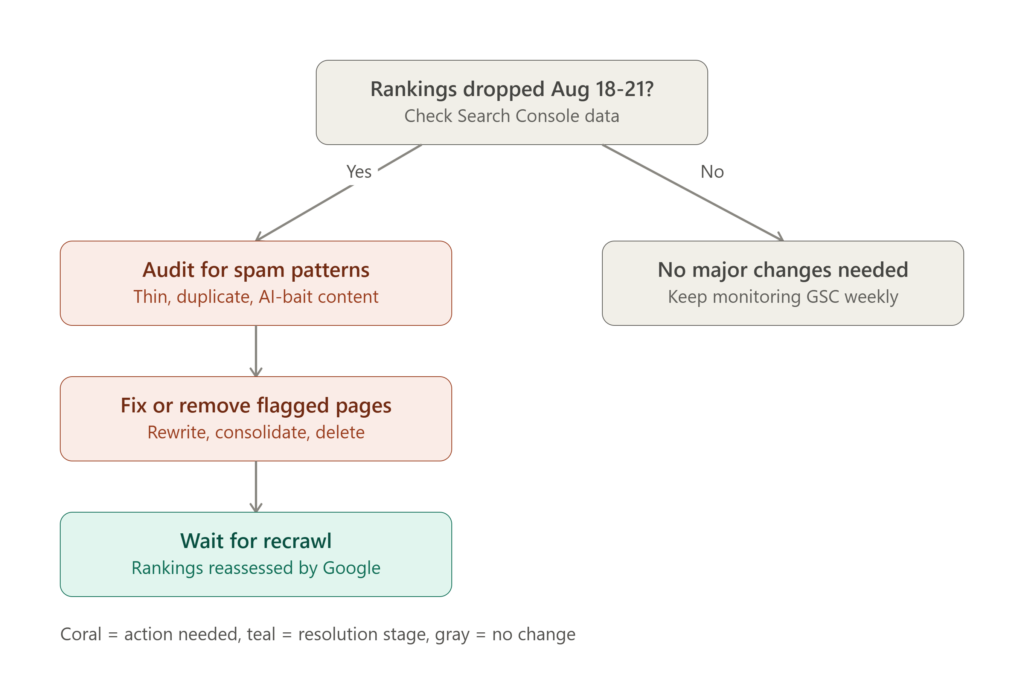
Recovery from a spam action looks different from recovery after a core update. Spam updates target policy violations rather than quality signals broadly, so the fix is usually pretty direct: remove or substantially rework the offending content and practices, then wait for the next crawl and reassessment cycle. There’s no magic timeline here, but businesses that act quickly tend to see movement sooner than those who wait around hoping it resolves itself.
Immediate Fixes
- Audit thin and automated pages. Anything generated at scale with little human input or editorial review is worth reviewing first.
- Consolidate duplicate content. Multiple pages competing for the same query dilute authority and raise red flags, especially when they closely mirror content elsewhere on the site.
- Clean up manipulative internal linking. Natural, contextual links read very differently to Google’s systems than exact-match anchor text stuffed into every paragraph.
Longer-Term E-E-A-T Signals
- Strengthen author and source signals. Real bylines, clear credentials, and cited data give both Google’s crawlers and AI summarization systems something concrete to trust.
- Prioritize original reporting or analysis. Even a single unique data point, case study, or first-hand observation can separate a page from the sea of rewritten content Google is actively targeting.
- Check for AI-manipulation patterns specifically. Content stuffed with unnatural question-and-answer blocks purely to bait an AI Overview snippet, without genuinely answering the question well, falls into the exact category this update expanded enforcement against.
None of this requires a full rebuild of a site. Most businesses find that a handful of pages are doing the damage. Fixing or removing those pages resolves the bulk of the exposure.
Frequently Asked Questions
Did the August 2026 update introduce new spam policies?
No. Google confirmed the update enforces existing spam policies rather than introducing new categories. The change is in enforcement, which now extends more aggressively into content built to manipulate AI Overviews and AI Mode.
How long did the rollout take?
The rollout ran from August 18 to August 21, 2026, about two days and sixteen hours, and covered all languages and regions at once.
How is this different from a core update?
A core update reassesses ranking quality broadly across the web. A spam update is narrower and targets specific policy violations, such as automated content, cloaking, and link schemes, along with newer AI-search manipulation tactics.
How do I know if my site was hit by this update?
Look for a sharp drop in impressions or clicks around August 18 to 21, especially on thin, automated, or heavily duplicated pages, with no other clear cause like a site migration or seasonal dip.
Can a site recover after this update?
Yes. Since spam updates target specific violations rather than overall site quality, removing or reworking the affected pages and strengthening E-E-A-T signals typically leads to recovery once Google recrawls and reassesses the site.
A Longer-Term Shift, Not a One-Off Event
The bigger story here isn’t the two-and-a-half-day rollout window itself. It’s what the update signals about where Google is heading. Spam enforcement and AI search integrity are converging, and content strategies built purely around keyword coverage, without genuine substance, are running out of room. Businesses that invest in real expertise, transparent sourcing, and content that actually helps the reader are the ones best positioned to stay stable through updates like this, and whatever comes next later this year.
For businesses trying to make sense of how these updates affect their own visibility, a professional audit against current E-E-A-T and spam policy standards is often the fastest way to find out where the actual risk sits. Techbound Digital Marketing Agency has been tracking Google’s algorithm changes and helping businesses in Kerala and beyond adjust their SEO strategy accordingly since 2009.