A digital marketing course in 2026 needs to teach a very different skill set than it did just a few years ago. AI tools have taken over large chunks of work that used to fill entire job descriptions. Search behavior has shifted toward AI-driven answers instead of traditional results pages. As a result, the gap between someone who “knows social media” and someone who can actually run a results-driven campaign has never been wider.
That shift is exactly why choosing the right course matters more than it used to. A program still teaching last decade’s playbook can leave a graduate with outdated skills the moment they finish.
If you’re weighing whether to invest time and money into digital marketing training this year, it helps to understand what’s actually changed, which skills are worth prioritizing, and how to spot a program that will genuinely prepare you.
What's Different About Digital Marketing in 2026
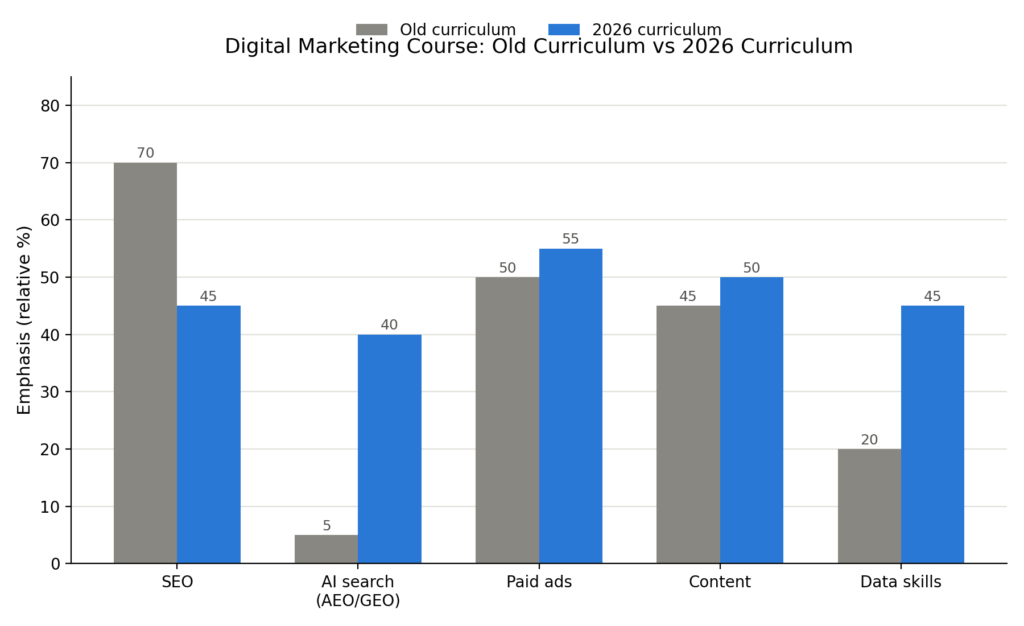
A few years ago, a typical curriculum centered around SEO basics, running social pages, and a few paid ad campaigns. That foundation still matters. However, it’s no longer enough on its own.
Search itself has changed fundamentally. A growing share of queries are now answered directly by AI systems like Google’s AI Overviews, ChatGPT, and Gemini. Often, the user never clicks through to a website at all. Because of this, marketers need to understand not just traditional SEO, but how to get content cited inside AI-generated answers, a discipline often called AEO or GEO (Answer/Generative Engine Optimization).
AI tools have also reshaped daily work. Tasks that once took hours drafting ad copy, generating content variations, analyzing campaign data can now be done in minutes. This doesn’t eliminate the need for marketers. Instead, it changes what they need to be good at: strategic thinking, campaign judgment, and knowing how to direct AI tools effectively.
Skills That Actually Matter Right Now
Not every skill taught in a typical course carries equal weight anymore. A few areas stand out as genuinely important today:
- Search visibility across both traditional and AI-driven channels how content gets found on Google, and increasingly, how it gets cited inside AI answers
- Data literacy reading campaign analytics and translating numbers into decisions, not just running campaigns and hoping for the best
- AI tool fluency using AI platforms to speed up content creation, research, and analysis without losing quality
- Paid advertising strategy budget allocation, targeting, and how ad formats are evolving as platforms roll out AI-powered ad types
- Content strategy grounded in real audience research, not just posting on a schedule
Here’s how a typical curriculum has shifted:
What to Look for Before Choosing a Course
Not all digital marketing courses are built the same way. The difference often shows up only after enrollment, so it helps to check a few things first:
- Does the curriculum reflect how the field works today, or does it still center on tactics that mattered five years ago?
- Is there real client work or practical application, rather than only theory and slides?
- Are the instructors actual practitioners with current, hands-on experience?
- Does the course treat AI tools and AI-driven search as core content, not an afterthought?
A course that answers these clearly tends to prepare students far better than one leaning on a long syllabus alone.
Why Practical Experience Matters More Than Theory Alone
Digital marketing is a practical discipline at its core. Understanding a concept in a classroom is very different from applying it when a real campaign underperforms or a piece of content isn’t ranking. Therefore, courses that build in real or simulated client work tend to produce far more job-ready graduates than those built purely around lectures.
This is also where learning from active practitioners makes a difference. Someone currently running campaigns and adjusting strategy in real time brings a different kind of knowledge than a textbook written years ago. A structured digital marketing agency in Trivandrum like Techbound, running live client campaigns alongside its training, offers exactly this kind of exposure.
Why Real Client Projects Beat Theory-Only Learning
Two students can finish the same digital marketing course with very different levels of readiness. The difference almost always comes down to one thing: did they work on real accounts, or only study concepts in isolation? Theory explains what SEO, paid ads, or content strategy are supposed to do. Real client work shows what actually happens when a campaign underperforms, a client changes direction midway, or a piece of content doesn’t rank as expected.
This is exactly why Techbound structures its digital marketing course around live client projects rather than simulated exercises alone. Students work alongside practitioners actively managing real accounts across SEO, paid ads, social media, and content. As a result, they see firsthand how strategy gets adjusted based on real data, not textbook assumptions. That kind of exposure builds judgment in a way theory alone simply can’t.
Scope and Career Opportunities in Digital Marketing
Digital marketing remains one of the fastest-growing career paths. Nearly every business regardless of size or industry now needs a digital presence to compete, and that demand isn’t slowing down. If anything, the rise of AI-driven search and AI-powered ad formats has created entirely new specializations that didn’t exist a few years ago, from AI search visibility to prompt-driven campaign management.
Career paths after a solid digital marketing course span a wide range: SEO specialist, paid ads strategist, content marketer, social media manager, performance marketing analyst, and increasingly, roles focused specifically on AI-driven search optimization. Many graduates also go on to freelance or manage their own client accounts, since digital marketing skills transfer directly into independent, client-facing work.
For those completing their training with real client exposure the kind Techbound’s course is built around the transition into any of these roles tends to be smoother, simply because the learning already happened in a real-world context.
Frequently Asked Questions
Is a digital marketing course still worth it with so many free resources online? Structured courses offer something free content usually can’t a coherent curriculum, hands-on practice, mentorship, and accountability, which matters especially for beginners.
How important is it for a course to cover AI tools? Very important. AI is now deeply embedded in daily marketing work, and a course that skips it teaches an incomplete picture of the field.
Do digital marketing courses guarantee a job afterward? No legitimate course can guarantee employment. However, courses with real client work and current, industry-relevant curriculum tend to produce more job-ready graduates.
Should beginners choose online or offline digital marketing courses? It depends on learning style and schedule flexibility. Both formats work well as long as the curriculum stays current and includes hands-on practice.
Making the Decision
A good digital marketing course in 2026 should leave you able to do two things: understand how the field works today, including where AI fits in, and apply that understanding to real problems. If a program can’t clearly explain how it covers both, it’s worth asking more questions before enrolling.
The businesses hiring digital marketers are increasingly looking for people who can work alongside AI tools, not compete with them. Choosing a course that reflects that reality makes a real difference in how prepared you are once you start working instead of one still teaching the field as it existed years ago. According to Coursera’s 2026 marketing trends overview, AI fluency and short-form content skills are now among the most in-demand marketing competencies. This reinforces why curriculum relevance matters more than ever.
Techbound offers a digital marketing course built around how the field actually works in 2026 real client work, current AI-driven strategy, and practitioner-led training.