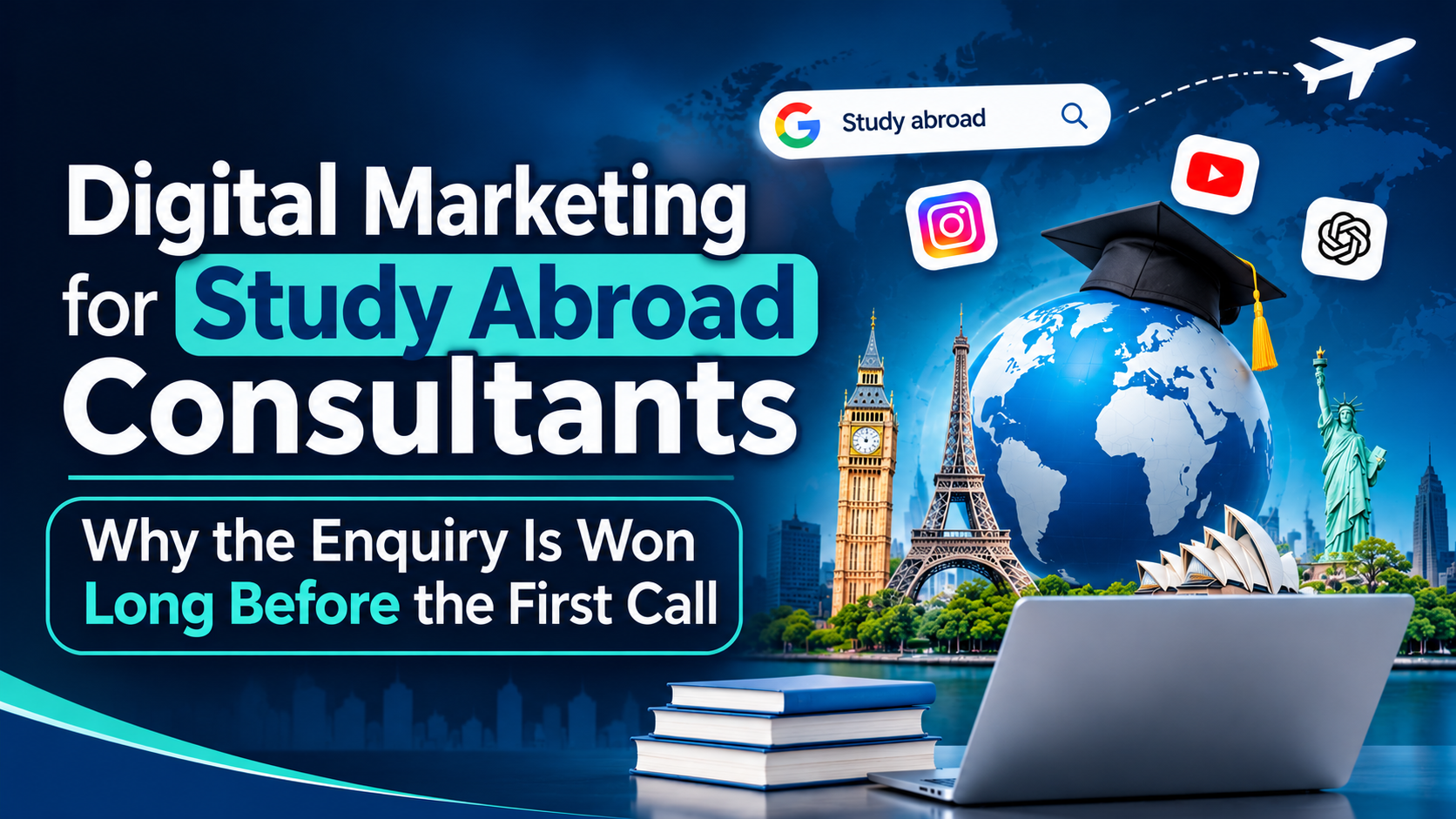
Digital marketing matters for study abroad consultancies because students and parents spend weeks researching countries, courses, costs and consultants online before they talk to anyone. The consultancy that shows up on Google, Google Maps, Instagram and AI answers, with honest and detailed information, gets the first call. The one that doesn’t show up rarely even makes the shortlist.
Here’s a scene you’ve probably watched play out. A parent in Kerala sits with their son after dinner, phone in hand. A YouTube video about Germany leads to a Google search about fees, then a quick look at three consultancies’ reviews, and a message to a cousin who’s already abroad. Nobody has spoken to a counsellor yet.
That’s the part many consultancies miss. The enquiry doesn’t begin at your front desk. It begins in a search bar, and by the time someone finally calls you, they’ve often half-decided already.
Where Do Students Actually Start Their Study Abroad Search?
Almost never with a consultant. They start with a question. Which country suits me? What will it really cost?
Here’s how that journey usually looks, and where your consultancy can step in.
| Stage | What the student or parent is thinking | Where they look | What they need to see from you |
|---|---|---|---|
| Dreaming | “Which country suits me?” | YouTube, Instagram Reels, Google | Honest country guides and cost breakdowns |
| Comparing | “Which course, which intake, what budget?” | Google, AI tools, university websites | Course, intake and fee information, clearly laid out |
| Shortlisting consultants | “Who can I trust with this?” | Google Maps, reviews, your website | Counsellor profiles, your process, real reviews |
| Deciding | “Will they be honest about visa risk?” | WhatsApp, a phone call, a visit | Quick replies and straight answers |
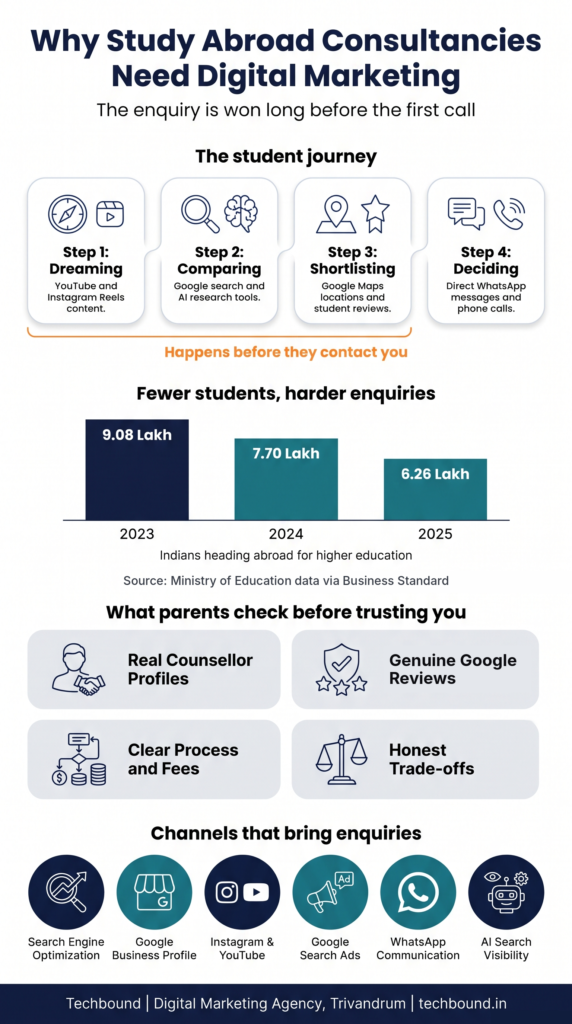
Look at that table again. Three of the four stages happen before anyone contacts you. Digital marketing is simply how you show up in those three.
Why Is Winning Student Enquiries Getting Harder?
Because there are fewer students to go around, and the ones who do go are choosing far more carefully.
The Ministry of Education told the Rajya Sabha that the number of Indians heading abroad for higher education fell from 9.08 lakh in 2023 to 7.7 lakh in 2024, and then to 6.26 lakh in 2025. Business Standard’s report on the drop ties it to tighter visa rules and rising cost pressures in popular destinations like Canada.
When the pool shrinks, every enquiry has to be earned. Students compare countries, budgets and job prospects far more than they used to, so there are more questions and more reading before anyone commits. A consultancy that answers those questions in public earns attention. One that only posts intake posters doesn’t.
What Does a Parent Check Before Trusting a Consultancy?
Trust. That’s the whole decision, really. Parents are handing over a large sum of money and, far more importantly, a child’s future.
They also read the news. Government data shared in Parliament has pointed to visa violations and incomplete documentation among the reasons for deportations, so families have every reason to be careful. In our work with enquiry-driven businesses, people look for the same quiet signals every time:
- Real names and photos of your counsellors, not a stock-photo team
- Google reviews that mention specific outcomes, with replies from the owner
- A plain explanation of your process, your fees and what you cannot guarantee
- The same name, address and phone number on your website and your Google Business Profile
- Content that admits trade-offs, like which country is cheaper but harder for part-time work
That last one matters more than most consultancies realise. Content written from real counselling experience reads very differently from generic copy, and both people and search engines can tell. Google’s own guidance on creating helpful, people-first content puts first-hand experience and trustworthiness right at the centre.
Which Digital Channels Actually Bring Study Abroad Enquiries?
No single channel does it all. Each one handles a different part of the journey.
| Channel | What it does for enquiries | Common mistake |
|---|---|---|
| SEO and blog content | Catches students searching country, course and visa questions | One generic “Study Abroad” page trying to cover every country |
| Google Business Profile | Helps you appear for “study abroad consultants near me” | Unanswered reviews and outdated details |
| Instagram and YouTube | Builds familiarity before the student ever enquires | Posting only offers and intake posters |
| Google Ads | Brings intent-ready traffic during intake seasons | Sending every click to the homepage |
| Turns interest into a counselling slot | Slow replies and no clear next step | |
| AI search visibility | Gets you named when students ask AI tools | Thin pages that no AI engine can quote |
Two of these deserve a closer look. Students now ask AI tools things like “best countries for an MBA on a low budget”, and the sources those tools quote tend to be clear, well-structured, trustworthy pages. We break down how that works in our guide to AI search visibility and GEO.
Social is the other one. A student scrolling Reels isn’t ready to enquire, but they are ready to remember you. Our social media marketing guide covers how to build that familiarity without turning your page into an ad feed.
Why Do Some Consultancy Websites Get Clicks but No Enquiries?
We hear this one a lot, and the answer is usually a bit boring: the page doesn’t answer what the visitor came to find out.
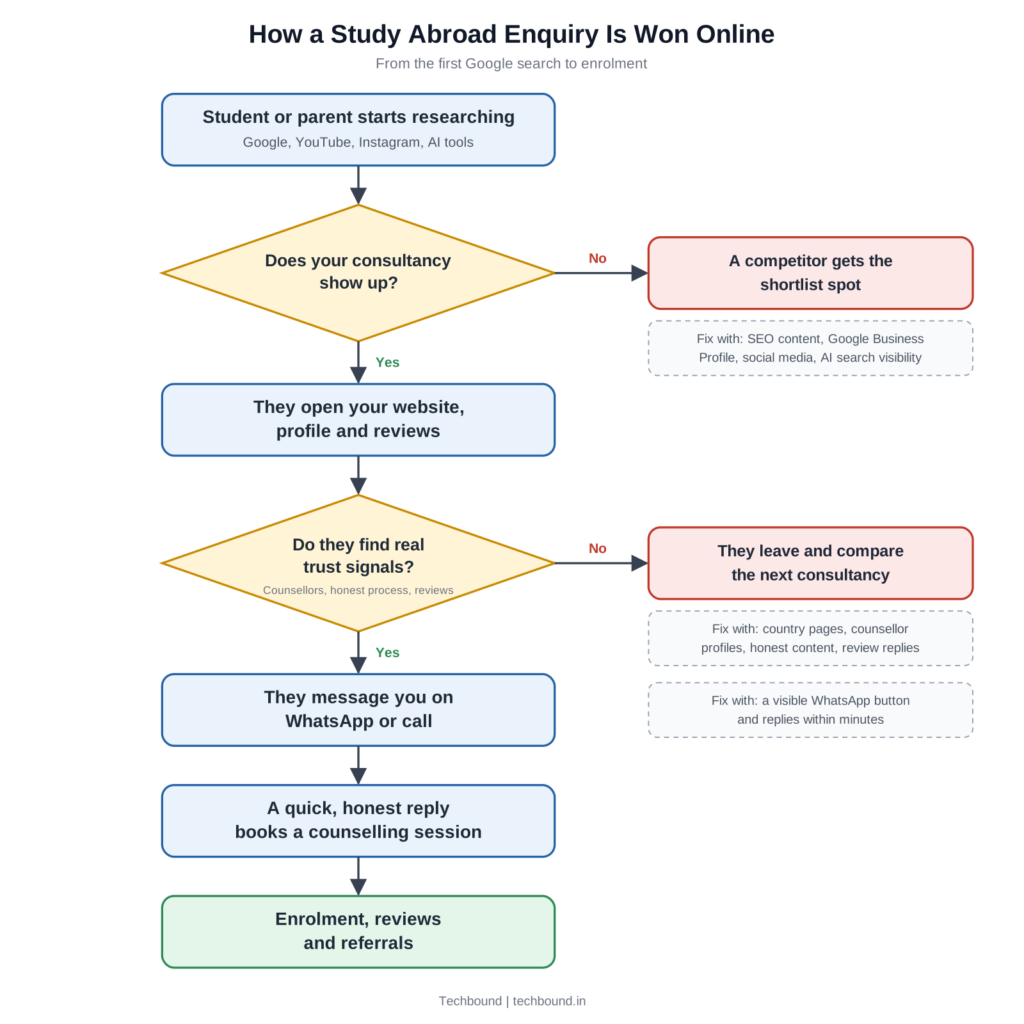
The flowchart below shows the two points where most consultancies quietly lose the student.
The same patterns keep showing up:
- No dedicated country or course pages. Someone searching “MBBS in Georgia fees” lands on a page about “our services” and leaves.
- No people. No counsellor profile, no office photo, nothing to suggest a human is on the other end.
- Big promises. “100% visa success” makes careful parents more suspicious, not less.
- Slow mobile pages. Most of these visitors are on a phone, often on average mobile data.
- A hidden contact option. If the WhatsApp button needs hunting, they’re on to the next consultancy.
Fixing these usually does more for enquiries than doubling the ad budget.
What Can Study Abroad Learn from Other High-Trust Industries?
Quite a lot, actually. Study abroad has the same shape as real estate and healthcare: a big decision, a long comparison phase, and a customer who wants reassurance before committing.
When we work with real estate businesses, the ones that win enquiries are the ones that answer the awkward questions early. We wrote about this in digital marketing for real estate business growth. The same idea shows up in digital marketing for healthcare providers, where credibility signals often decide whether a patient picks up the phone. A study abroad consultancy that explains its process, costs and limits openly will stand out in a market full of polished promises.
How Do You Know Digital Marketing Is Working for Your Consultancy?
Likes and impressions won’t pay the rent. Track the numbers that sit closer to the counselling room:
- Qualified enquiries per month, split by source (search, Maps, Instagram, ads, WhatsApp)
- Counselling sessions booked from those enquiries
- Cost per qualified enquiry, not cost per click
- Enquiry-to-enrolment rate for each country or course you promote
- Review count and rating trend on Google
Give organic channels a few months before judging them. SEO and content build slowly, while ads show results faster but stop when the budget stops. A sensible plan uses both: content and local visibility for steady enquiries, ads for the intake-season rush.
Here’s the whole picture on one page, in case you want to save it for later.
Frequently Asked Questions
Is digital marketing really necessary for a study abroad consultancy?
Yes. Students and parents research online before contacting anyone, so a consultancy with no visible online presence often never gets shortlisted, however good its counselling is.
Which digital marketing channel gives the best study abroad enquiries?
There’s no single winner. SEO and Google Business Profile bring steady, high-intent enquiries, while Google Ads help during intake seasons. Instagram and YouTube build the familiarity that makes people more likely to call.
How long does SEO take to bring student enquiries?
It depends on competition and the state of your website, but most consultancies should expect a few months of consistent work before organic enquiries grow noticeably.
Can a small consultancy compete with big national names?
Yes. Local visibility, country-specific content and genuine reviews let smaller consultancies win searches that large brands treat too generically.
If your consultancy gets website visits but not enough counselling calls, the gap is usually in how your online presence builds trust, not in how much traffic you buy. As a digital marketing agency in Trivandrum, we help enquiry-driven businesses turn that online research phase into real conversations.