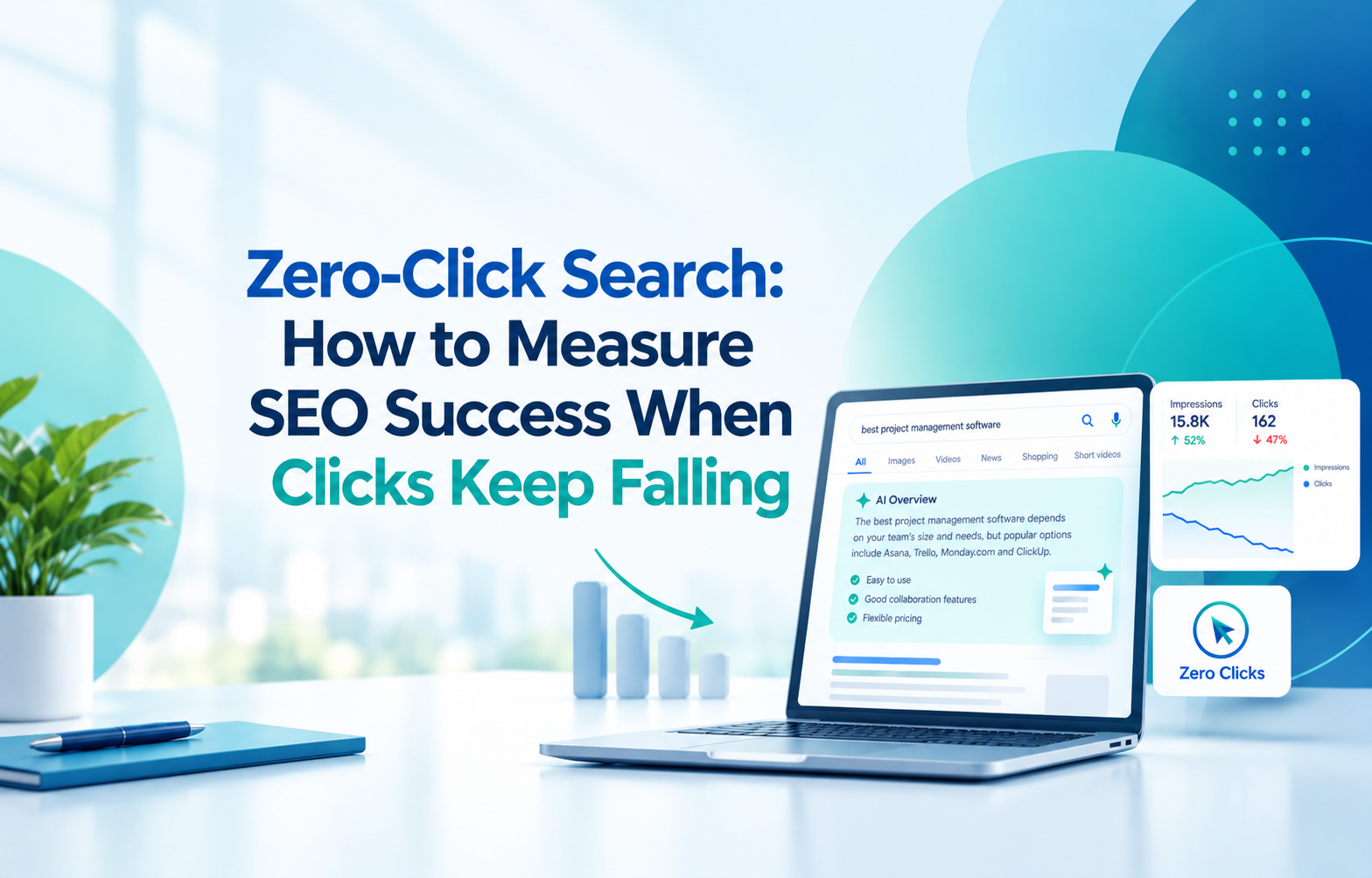
You open your monthly report and the traffic line is sloping down. Rankings haven’t moved much. Nobody has changed the website. Yet the number you’ve been told to care about keeps shrinking, and someone in the room asks the question: “Is our SEO still working?”
Maybe it isn’t. But before you answer, it helps to know that search itself has changed. Google now answers a growing share of questions without sending anyone anywhere. Here’s how to judge your results fairly when that happens.
Zero-Click Search, Explained Simply
A zero-click search ends on the results page. The person types a question, reads the answer in a box, a map listing or an AI overview, and leaves satisfied. No website visit, so no click to count.
The numbers behind this are large. SparkToro’s study of US Google searches from January to April 2026 found that around 68% ended without a click. Keep in mind that this is US data, so Indian figures will differ, and the researchers themselves call AI Overviews a likely factor rather than a proven one. Still, the direction is hard to argue with.
Where the Value Goes When the Click Disappears
The visit doesn’t vanish. It often turns into something else, just somewhere your analytics can’t see.
A customer reads your reviews on the map and phones you directly. Someone sees your name in an AI answer and searches for you by name later that week. A buyer taps the WhatsApp button on your Business Profile and never touches your site. Each of those is a real result, and none of them is a click.
That’s the core problem with a traffic-only report. It counts the one outcome that’s shrinking and ignores the ones that are growing.
Five Numbers That Say More Than Traffic
1. Impressions, Read Query by Query
Impressions count how often your pages showed up, and clicks count visits, as Google’s Performance report explains. A sitewide impressions total can look fine while one valuable query quietly collapses. So compare two periods, sort the query list by change, and look at the biggest movers.
2. Branded Searches
When people search for your business by name, an earlier touchpoint did its job, whether that was a referral, a review or a brand mention somewhere else. In Search Console, filter queries with a regex like yourbrand|your brand and record the total monthly. A rising line is good news. A branded line that carries nearly everything is a warning that new customers aren’t discovering you.
3. Calls, Directions and WhatsApp Chats
For local and service businesses, this is the number that pays the bills. Google Business Profile reports calls, direction requests and website taps, and our write-up on Google Business Profile updates covers the return of post view counts. Tag your profile’s website link with UTM parameters, and keep a separate tally of WhatsApp enquiries.
4. Conversion Rate and Lead Quality
When fewer people arrive, each arrival should count for more. Doubling a page’s conversion rate has the same effect as doubling its traffic, and it’s usually cheaper. If your enquiry pages feel weak, these signs your website isn’t built to convert are a good checklist. Beyond counting leads, track how many turned into real conversations.
5. AI Mentions and Citations
Pick 10 to 15 questions your customers actually ask. Once a month, put them into Google’s AI features and a couple of chat assistants, then note whether your business is named or your pages are cited. Search Console’s AI Overviews reporting offers a first signal, and our guide to checking if your business shows up in AI answers walks through the manual check. The method is rough, but a rough picture is better than none.
Reading the Signals Together
No single metric tells the whole story, so it helps to follow a simple path whenever clicks fall. Start with impressions, then work out whether the problem sits in visibility, citations, click-through, or somewhere off your website entirely.
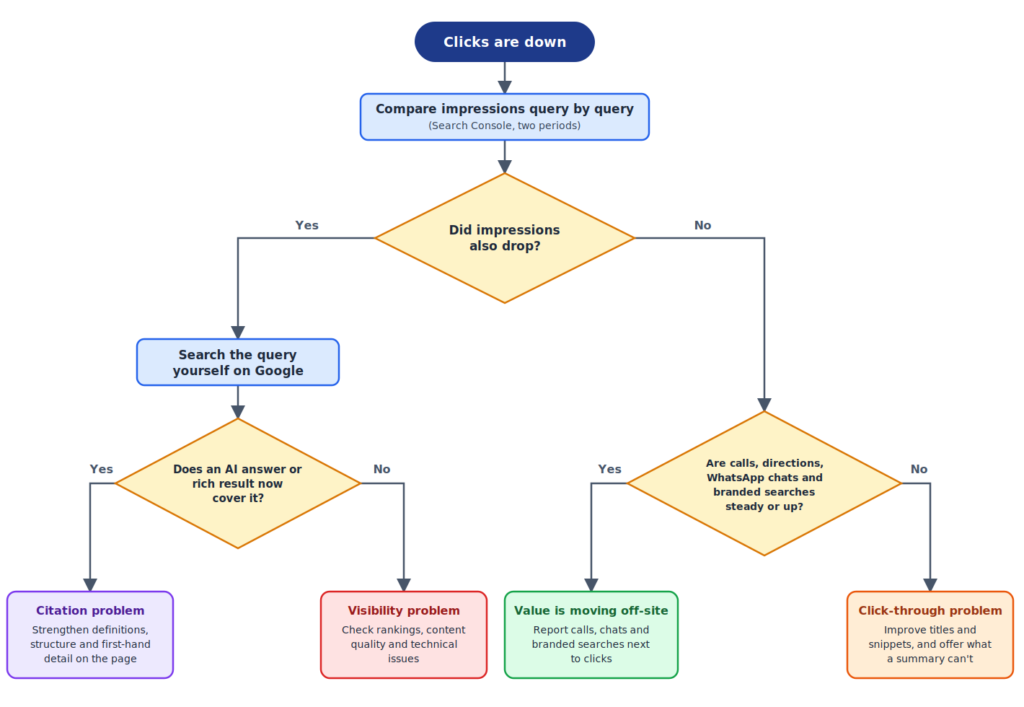
A quick way to diagnose falling clicks before changing anything on your site.
Each ending needs a different fix. A citation problem calls for better-structured, more experience-led content. A visibility problem sends you back to rankings and technical checks. A click-through problem is usually about titles, snippets and what your page offers that a summary can’t. And when calls, chats and branded searches hold steady, the value has simply moved off your site, so report it next to clicks.
Setting It Up in One Afternoon
You don’t need new software. Here’s a workable sequence:
- In Search Console, save a comparison of the last three months against the previous period.
- Add a branded-query filter and note the monthly total.
- Pull Business Profile calls, directions and website taps into one sheet.
- Add a “How did you find us?” dropdown to your enquiry form, and log WhatsApp chats separately.
- Write down your 10 to 15 priority questions and check AI answers once a month.
Put these five on one page. Traffic can still appear on it. It just shouldn’t open the report.
Content That Still Earns the Click
Some searches will always send visitors: comparisons, local decisions, pricing questions and anything that needs a tool, template or opinion. Build for those. On informational pages, give readers something a quick summary can’t replace, such as a worked example, a checklist or experience from real projects. A named author and specific detail also strengthen E-E-A-T, which helps with both search results and AI citations.
Frequently Asked Questions
Does zero-click search mean SEO is dying?
No. It means the click is one outcome among several. Visibility, brand recall and calls still come from good SEO.
Should I stop tracking organic traffic?
Keep it, but read it next to impressions, branded searches and conversions, not on its own.
How can I tell if an AI Overview is behind a drop?
Find queries where impressions fell sharply while average position stayed similar. Search them yourself and see whether an AI answer now appears.
Which metric matters most for a local business?
Calls and direction requests from your Business Profile, checked against how many enquiries became customers.
The Bottom Line
A falling traffic line is a prompt to look closer, not proof that something broke. Measure visibility, demand, action and lead quality together, and you’ll know whether your SEO is working even on the days Google keeps the click.
If you’d like help building a report along these lines, our team at Techbound, a digital marketing company in Trivandrum, is happy to talk it through.