
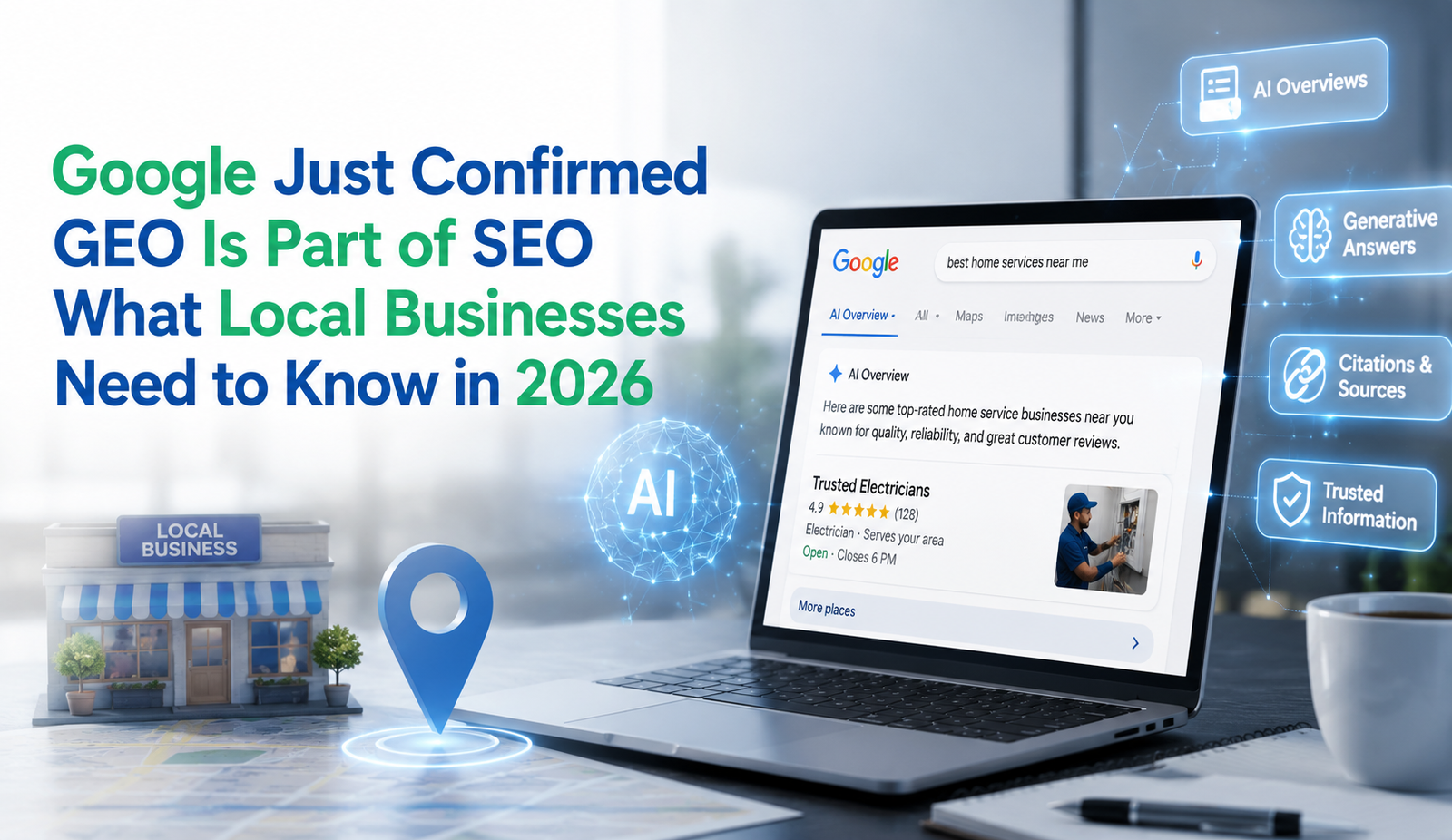
For years, “Generative Engine Optimization” sounded like a buzzword invented by marketing consultants t
rying to sell something new. In 2026, that changed. Google released official documentation on optimizing for generative AI features on Search, and in it, the company said something businesses have been debating for two years: optimizing for generative AI search is still SEO. Not a separate discipline. Not a new budget line. The same discipline, applied to a search experience that now includes AI-generated answers alongside or instead of the familiar list of blue links.
For local businesses, this is not just an industry footnote. It changes how they should think about visibility, and it explains why some websites are starting to show up inside AI Overviews and AI Mode responses while others, despite ranking well in traditional search, are invisible in those same answers.
Why This Google Update Matters Right Now
Search behavior has already shifted. A growing share of queries on Google now trigger an AI-generated summary before a user ever sees a traditional result. When that happens, the AI answer either mentions a business or it doesn’t. There is no “position two” the way there is on a search results page. A business is either part of the answer or invisible inside it.
Google’s documentation formalizing this as part of SEO tells businesses two things. First, the fundamentals that have always mattered are crawlability, clear site structure, accurate and well-organized content remain the foundation. Second, there is now an additional layer on top of that foundation: content needs to be written in a way that AI systems can extract, verify, and confidently cite.
The Shift From Rankings to Citations
Traditional SEO has one unit of success: where a page lands on a results page. Generative search introduces a different unit: whether a page gets pulled into an AI-generated answer at all. These two goals overlap heavily but are not identical. A page can rank well and still get skipped by an AI summary if its information is scattered, vague, or hard to verify at a glance.
This is where most local businesses fall behind not because their SEO is weak, but because their content was written for humans scanning a page, not for a system trying to lift a clear, standalone answer out of it.
What Local Businesses Should Actually Do
The good news is that none of this requires abandoning existing SEO work. It requires sharpening it. A few practical shifts make the biggest difference for local businesses adapting to this update.
1. Write Direct, Extractable Answers
AI systems favor content that states things plainly. A page that opens with a clear definition, a direct answer, or a specific data point is far easier to cite than one that builds up to its point slowly. This does not mean writing for machines instead of people clear, direct writing tends to serve human readers better too.
2. Keep Content Structured and Consistent
Headings that accurately describe the section beneath them, short paragraphs, and consistent formatting all help both readers and AI systems parse a page correctly. Inconsistent structure of a page that jumps between topics without clear headings makes it harder for any system, human or AI, to extract a confident answer.
3. Treat Freshness as a Ranking Signal, Not a Formality
AI systems weigh how current a source appears to be. A cornerstone page written two years ago and never revisited is at a disadvantage against a competitor’s page updated this year, even if the original content was excellent. Regularly refreshing key pages, updating data points, and marking a visible “last updated” date signals ongoing reliability.
4. Build Entity Clarity Across the Web
A business’s presence on its own website is only one signal. Google Business Profile listings, directory entries, review platforms, and social profiles all contribute to how confidently an AI system can verify who a business is and what it does. Inconsistent business names, addresses, or descriptions across these platforms weaken that trust a detail many small and mid-sized businesses overlook.
5. Prove Expertise, Don't Just Claim It
This is where E-E-A-T principles experience, expertise, authoritativeness, and trustworthiness become practical rather than theoretical. Original insights, specific local knowledge, and content written by people who clearly understand the subject carry more weight than generic, templated pages. AI systems are increasingly good at distinguishing genuinely useful content from content written only to fill a page.
This Isn't a Separate Strategy It's a Sharper One
The most important takeaway from Google’s 2026 documentation is reassurance, not disruption. Businesses that have already invested in solid SEO fundamentals, clean site architecture, honest and well-organized content, credible off-site presence are closer to being AI-search-ready than they might think. What changes is the level of precision required. Vague, generic pages that used to rank “well enough” now need to work harder to earn a citation inside an AI-generated answer.
For local businesses, this is also a leveling moment. Being cited inside an AI answer depends far less on domain age or advertising budget than traditional rankings often did. It depends on clarity, accuracy, and how confidently a system can verify what a business offers. A well-structured, honestly written local business page can compete for AI visibility in ways it sometimes couldn’t compete for page-one rankings against much larger sites.
Frequently Asked Questions
What is Generative Engine Optimization (GEO)?
GEO is the practice of structuring website content so AI-powered search engines and answer platforms can accurately interpret, trust, and cite it in their generated responses.
Is GEO different from SEO?
Not anymore, according to Google’s 2026 documentation. Google now frames optimizing for generative AI search as part of standard SEO, not a separate strategy or discipline.
Why do some well-ranking pages not appear in AI-generated answers?
A page can rank well in traditional search and still be skipped by an AI summary if its content is vague, scattered, or hard to verify at a glance. AI systems favor content that states information clearly and directly.
How often should a business update its website content for AI search visibility?
Regularly. AI systems weigh recency when selecting sources, so cornerstone pages should be refreshed periodically with updated information and a visible “last updated” date.
Does business size affect visibility in AI-generated answers?
Less than it does in traditional rankings. Being cited in an AI answer depends more on clarity, accuracy, and verifiable trust signals than on domain age or advertising budget, giving smaller businesses a more even playing field.
Final Thoughts
Google’s move to formally document generative AI optimization as part of SEO closes a debate that has run for the better part of two years. It confirms that businesses do not need to chase two separate strategies, they need one strategy, executed with more precision than before. For local businesses navigating this shift, the priority is straightforward: structure content clearly, keep it current, stay consistent across every platform that represents the business online, and write with the kind of direct expertise that both readers and AI systems can trust.
As search continues to evolve, agencies that understand both the technical and content sides of this shift like TechBound digital marketing agency will be the ones helping local businesses stay visible, whichever way a search result gets delivered.