
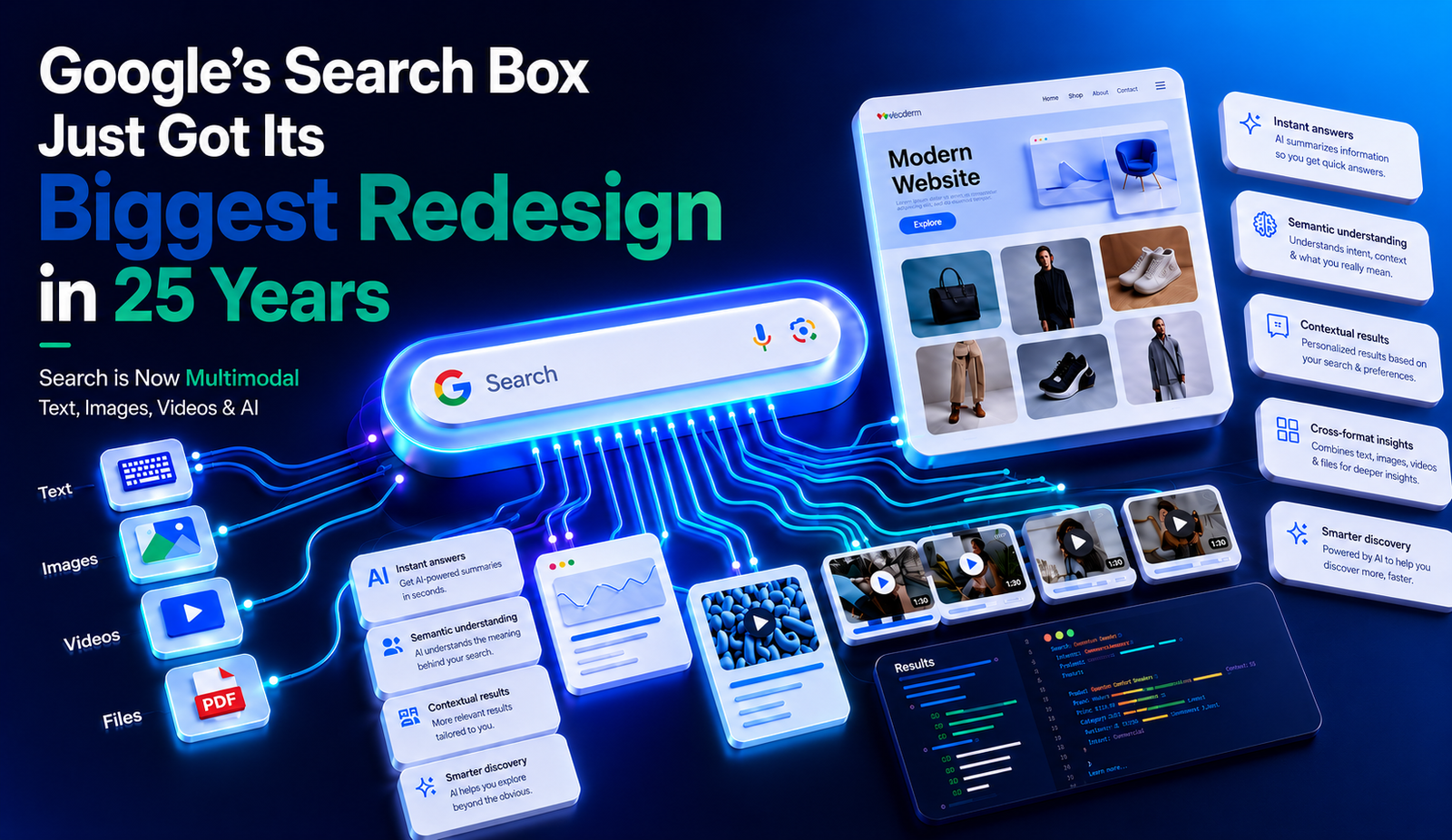
For a quarter of a century, searching on Google meant one thing: typing words into a box. That’s changed. Google has rebuilt its search box for the first time in 25 years it now takes text, images, files, and video as input, not just typed queries. Alongside that, Google Images has been redesigned into a browsable, AI-powered visual discovery space.
For business owners and marketers, this isn’t just a cosmetic update. It changes how people find businesses online, and it quietly raises the bar for what “search-ready” content actually looks like.
What Actually Changed
Google’s search box now expands as you type and accepts multiple types of input at once. A user can drop in a photo, attach a document, or share a video clip alongside a typed question, and Google reasons across all of it to produce an answer. This flows directly from a traditional results page into an AI-generated overview, and from there into a back-and-forth conversation if the user wants to dig deeper.
Google Images has changed just as much. Instead of opening to a blank search bar, it now shows a live, personalized gallery of images pulled from across the web, updated in real time based on what a person has been browsing. Users can save images into themed collections, and Google has built in AI image generation directly into search results, so a person can turn a text description into a custom visual on the spot.
Both updates were framed by Google, in its own announcement, as building on 25 years of work to make visual information easier to find and use which is a reminder that visual search isn’t a new experiment. It’s been developing quietly for years, and it has now reached the point where it’s central to how Google Search works.
From Search Engine to Discovery Feed
What’s drawing the most attention is how the new Google Images homepage actually looks and behaves. Instead of a blank box waiting for a query, signed-in users now land on a “For You” gallery, a continuously updated feed of images tailored to their interests and browsing history, with the option to save ideas into named collections that sit as tabs above the feed. Anyone who has used Pinterest will recognize the pattern immediately, and several tech publications have described it exactly that way: Google borrowing a browsing-first, inspiration-led experience rather than sticking to its traditional search-first design.
This is a real shift in intent, not just design. A search box assumes you already know what you’re looking for. A discovery feed assumes you might not, and it invites you to browse first, search later. For businesses, that means a slice of future visibility could come from an image simply showing up in front of the right person at the right moment, not from anyone typing a query at all.
It’s worth noting this rollout is gradual and, for now, limited to signed-in users on desktop. Typing a specific query into Google Images still returns familiar, standard results the discovery feed is an added layer, not a replacement. But the direction is clear enough that it’s worth planning for now rather than after it reaches every market.
Why This Matters Beyond Search Engineers and Tech Blogs
It’s easy to file this under “interesting Google news” and move on. But three shifts here directly affect how discoverable a business is online.
Visual Content Is No Longer a Nice-to-Have
When a search engine can reason across an uploaded photo the same way it reasons across typed text, the images on a website stop being decoration. They become searchable, indexable content in their own right. A product photo, a before-and-after shot, an infographic, a team photo each of these is now a potential entry point into a search result, provided it’s set up correctly (clear file names, descriptive alt text, and context on the page around it).
Websites that have treated images as an afterthought, with generic file names or missing alt text, are at a growing disadvantage. This isn’t a new SEO rule; it’s an old one that has just become significantly more important.
Video Is Entering the Same Conversation
Because the new search experience accepts video as an input and reasons across it, video content is being pulled into the same visibility equation as written content and images. A business with an active, well-organized video presence think demo videos, explainer clips, or customer walkthroughs has more surface area for discovery than one with text alone.
Structured Data Does More Work Now
With AI systems reasoning across text, images, and video together, structured data (schema markup) becomes the connective tissue that helps Google understand what an image or video actually represents. Tagging images and videos properly, rather than leaving them as untagged files sitting on a page, gives search systems a clearer signal to work with.
What Businesses Can Actually Do About It
None of this requires a complete website overhaul, but it does call for a few deliberate habits going forward — the same fundamentals any digital marketing agency Trivandrum businesses work with would recommend as a starting point:
- Audit existing images for descriptive file names and alt text not keyword-stuffed, but genuinely descriptive of what’s in the image.
- Treat video as a content channel, not an afterthought. Even simple, authentic clips (a service explained, a process shown) add value that pure text can’t replicate.
- Add structured data (ImageObject, VideoObject, or relevant schema types) where it’s missing, so search systems have context to work with.
- Keep visual content fresh. Just as stale text content loses relevance over time, an outdated image library sends a weaker signal than one that reflects the current state of a business.
- Don’t chase the trend for its own sake. The goal isn’t to flood a site with AI-generated images it’s to make sure genuine, useful visual content is actually discoverable.
Frequently Asked Questions
Does this mean text-based SEO doesn’t matter anymore? No. Text content, keywords, and on-page structure remain the foundation. Visual and video optimization now sit alongside that foundation rather than replacing it.
Do I need video content to stay visible in search? Not strictly, but a growing share of searches now involve video as an input or a result format, so businesses without any video presence are missing a channel that competitors may already be using.
Is this update live everywhere? The new search box and Google Images redesign are rolling out gradually, starting with certain regions and languages before wider availability. It’s worth checking whether it’s active in your target market.
Final Thoughts
Search is steadily moving from a single text box toward a system that understands a mix of words, pictures, and video the way a person naturally would. For businesses, that changes the goalposts a little visibility is no longer just about ranking for the right words, but about being found across every format a customer might reach for.
Businesses that keep their visual and video content organized, well-labeled, and genuinely useful will be better positioned as this shift continues. It’s less about reacting to every Google announcement and more about building a website that reflects the real substance of a business, in whatever form a search engine chooses to look at it.
If you’re unsure whether your website’s images, videos, and structured data are set up to keep pace with these changes, TechBound’s SEO team can help you review what’s in place and what needs attention.