

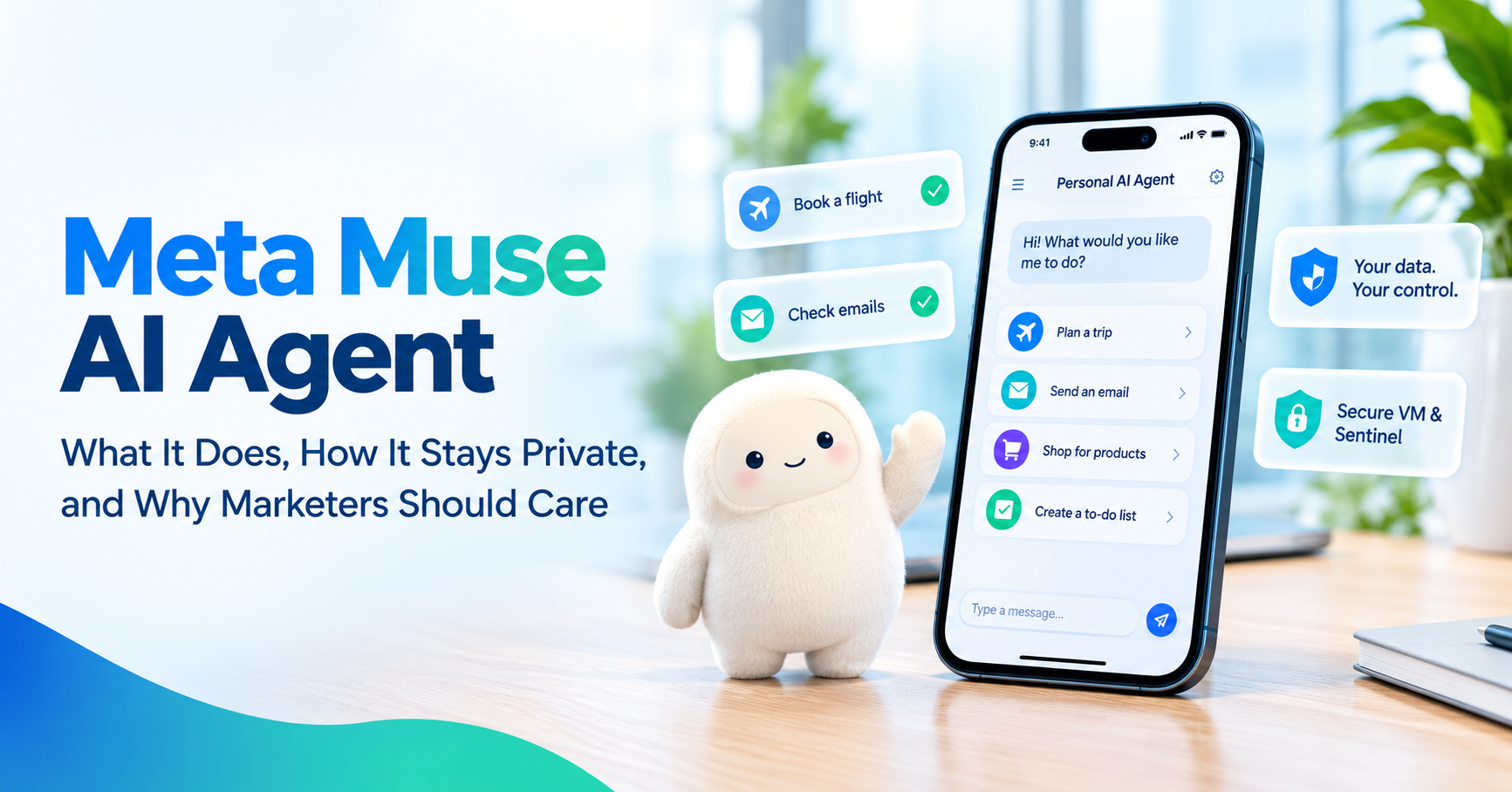
Most AI tools are very good at answering. You ask, they reply, and then you go and do the actual work yourself. Meta’s new personal AI agent, Muse, is aimed at that last step. Announced on September 8, 2026, it is built to take the task off your plate instead of just explaining how to do it.
We have been following this launch closely, partly as a tech story and partly because anything Meta ships tends to change how people find and buy things online. Here is what Muse is, how it handles privacy, and what it could mean for your business.
What Is Meta Muse?
Muse is a personal AI agent that you talk to like a person. You tell it what needs to get done, and it works on it, whether that is sending an email, booking travel, or turning a vague goal into a step-by-step plan. It keeps pushing the work forward and comes back when something changes or when it needs your approval.
The Model Behind It: Muse Spark
Muse runs on Muse Spark, which Meta calls its most capable model to date and one built for real-world agentic work. Think of it as the reasoning layer that lets Muse plan, use a browser and handle multi-step jobs without you checking every step.
How Meta Muse Works in Practice
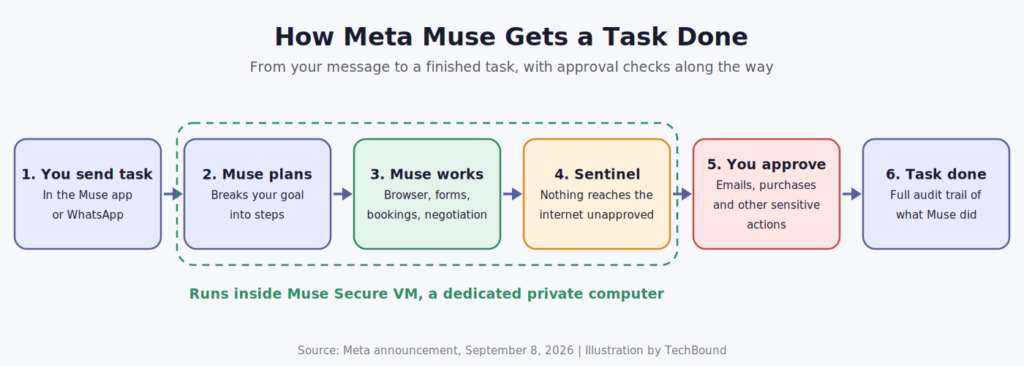
You can message Muse in its own app or directly inside WhatsApp, so there is almost nothing to learn. No prompt engineering, no technical setup.
Tasks That Keep Running in the Background
This is the real difference from a chatbot. Muse can open a browser, fill out forms and even negotiate on your behalf. For longer jobs it keeps working after you close the app. Meta’s own examples include selling a car for a better price, lowering a bill, or adjusting a training plan when your week changes.
Memory and Proactive Suggestions
Muse remembers what matters to you and can act on something you mentioned only once. Meta’s example: it turns a recipe reel you saved on Instagram into a grocery list, suggests a dinner menu, and remembers your friends’ dietary restrictions before the invites go out. You can tell it to forget specific things at any time.
Muse Secure VM: Privacy and Safety Controls
An agent that can read your email and buy things is only useful if you trust it, so this is where Meta has put most of its effort.
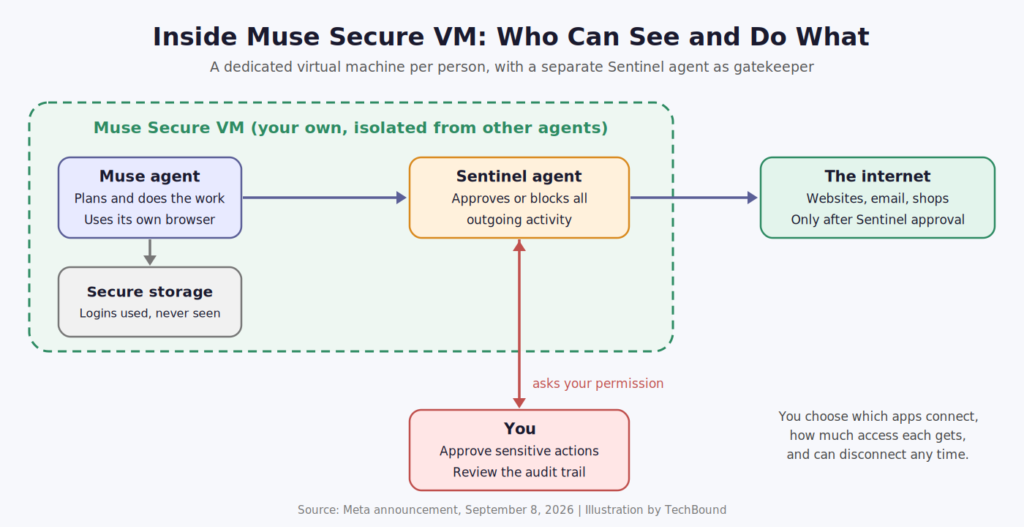
Muse runs on Muse Secure VM, a dedicated virtual machine that holds both the agent and your data, kept apart so no one else’s agent can reach it. A second agent called Sentinel runs on the same machine and screens what Muse sends out. Nothing reaches the internet unless Sentinel approves it.
You Stay in the Approval Seat
Muse checks with you before sensitive actions such as sending an email or making a purchase, and you get a full audit trail of what it has done and plans to do. You choose which apps it connects to and how much access each one gets. For email, that can mean read-only or read-and-send. You can change or cut off access whenever you like and opt out of your interactions being used to train Meta’s AI models. Meta also says Muse conversations and VM data are not shared with its ad systems.
Payments Through Link by Stripe
At checkout, Muse uses Link by Stripe, which creates a one-time-use card so your real card details stay hidden. Muse cannot see your saved passwords or payment methods. Later this year, Meta plans to add Muse Confidential VM, where everything is encrypted with a key only you hold.
Availability and Pricing
Muse is rolling out in the US on iOS, Android and muse.ai, with AI glasses support coming soon. It is free for most everyday needs, with subscription plans for heavier use. Regions and plans may change, so check Meta’s official Muse announcement for the latest.
What Muse Means for Marketers and Business Owners
When an agent researches and buys on someone’s behalf, the first “reader” of your content may be software. That does not make good marketing obsolete. It makes the fundamentals more visible.
Discovery Is Shifting Again
Agents lean on what the wider web says about you, which is why brand mentions are becoming the fuel for AI-driven visibility. To see where your own business stands today, our guide to checking your visibility in AI answers walks through it step by step.
Social Platforms Become the Front Door
Muse already works inside WhatsApp, and Meta has extended the idea to business owners. As CNBC reported, Muse for Small Business connects with tools like Asana, Zoom, Canva and Slack, plus Meta ad accounts and professional Instagram and Facebook profiles. That makes your social presence matter more. People already use Instagram and TikTok like search engines, which we covered in our social search strategy for 2026, and if your profiles are patchy, our social media marketing guide for 2026 is the place to fix the basics.
What We Would Do Right Now
Nothing dramatic. In the listing and profile audits we run, the most common problem is still inconsistent business details across platforms, and that is exactly what an agent will trip over first. So keep your name, address, phone and services identical everywhere. Answer real customer questions clearly on your pages. Keep reviews fresh. Then watch how your brand appears when someone asks an AI assistant instead of Google.
Frequently Asked Questions About Meta Muse
What is Meta Muse?
Muse is Meta’s personal AI agent. It carries out tasks like sending emails, booking travel and shopping, and keeps working on longer goals even after you close the app.
Is Meta Muse free?
It is free for most everyday needs, with paid subscription plans for people who want to do more. Check Meta’s page for current limits.
Where can I use Muse?
In the Muse app on iOS and Android, on muse.ai, and inside WhatsApp. AI glasses support is listed as coming soon, and the initial rollout is in the US.
Is it safe to connect Muse to my email and accounts?
Meta built in approval checks before sensitive actions, a full audit trail and a separate Sentinel agent that screens outgoing activity. You set the access level per app and can revoke it anytime. As with any agent, grant only the access you actually need.
Can Muse see my passwords or card details?
Meta says no. Shared credentials go into secure storage that Muse can use without seeing, and payments use a one-time-use card through Link by Stripe.
Does Muse change how businesses should approach SEO?
It adds a layer rather than replacing the old one. Solid SEO still matters, and clear, trustworthy content also helps AI systems understand and recommend you.
We at TechBound, a digital marketing agency in Trivandrum, will keep tracking how personal AI agents influence search and discovery, and we will update this guide as Meta shares more.