

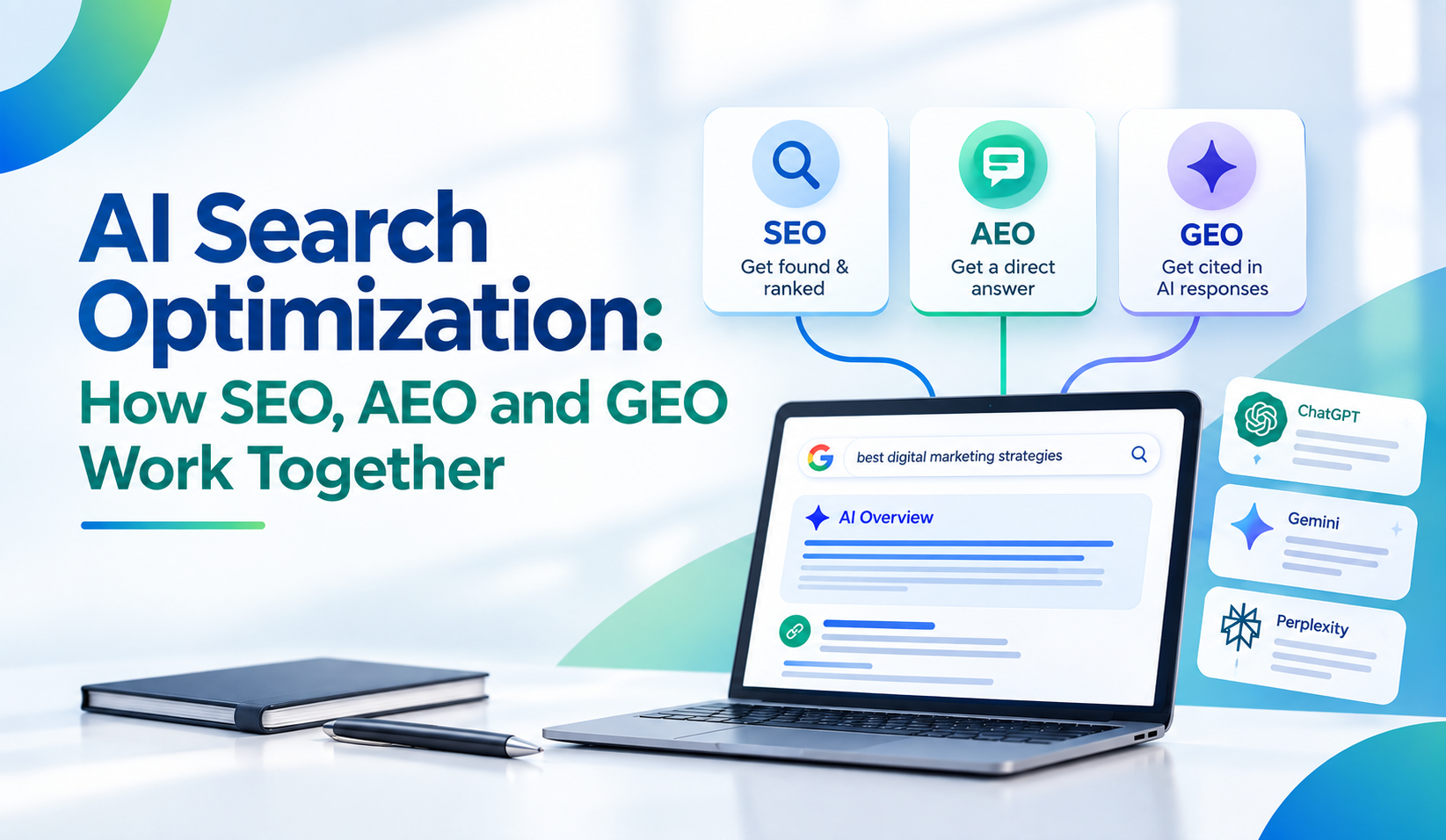
Search no longer ends with ten blue links. People now get answers from AI Overviews, AI Mode, ChatGPT and Gemini, often before they click anything. That has produced a pile of new acronyms, and many business owners are asking whether they need a separate strategy for each one. In our experience the answer is no. This guide explains what AI search optimization actually means, how SEO, AEO and GEO fit together, and how to build pages that work across all three.
What Is AI Search Optimization?
AI search optimization is the practice of making your content easy for both people and AI systems to find, understand, trust and quote. It is not a replacement for SEO. It is SEO plus a few extra habits that help answer engines pull a clear, accurate response from your page.
If you are a business owner asking “why is my traffic falling when my rankings look fine,” or a marketer asking “what should I change first,” this is the framework we use to answer both.
SEO: the foundation
SEO covers crawlability, indexing, site speed, internal links, relevant keywords and backlinks. Without it, nothing else works, because an AI system cannot cite a page that search engines cannot reach.
AEO: the answer layer
AEO is about structure. It means placing a short, direct answer under a question-style heading, then supporting it with detail. Think of the way a helpful colleague answers: the answer first, the explanation after.
GEO: the citation layer
GEO is about trust and authority. Generative systems tend to quote sources that are clear, consistent and credible across the web. That means named authors, original data, accurate facts and a brand that appears in reliable places.
What Google Says About Optimizing for AI Features
It helps to check the source. Google’s own guidance on AI features and your website states that the best practices for SEO remain relevant for AI Overviews and AI Mode, and that no extra requirements or special optimizations are needed to appear in them. The same page explains that these features may use “query fan-out,” which means running several related searches across subtopics to build one response.
That detail matters. If a system breaks one question into many smaller ones, a page that covers a topic in depth, with clear sub-answers, has more chances to be picked up than a thin page aimed at a single keyword.
How to Optimize One Page for SEO, AEO and GEO
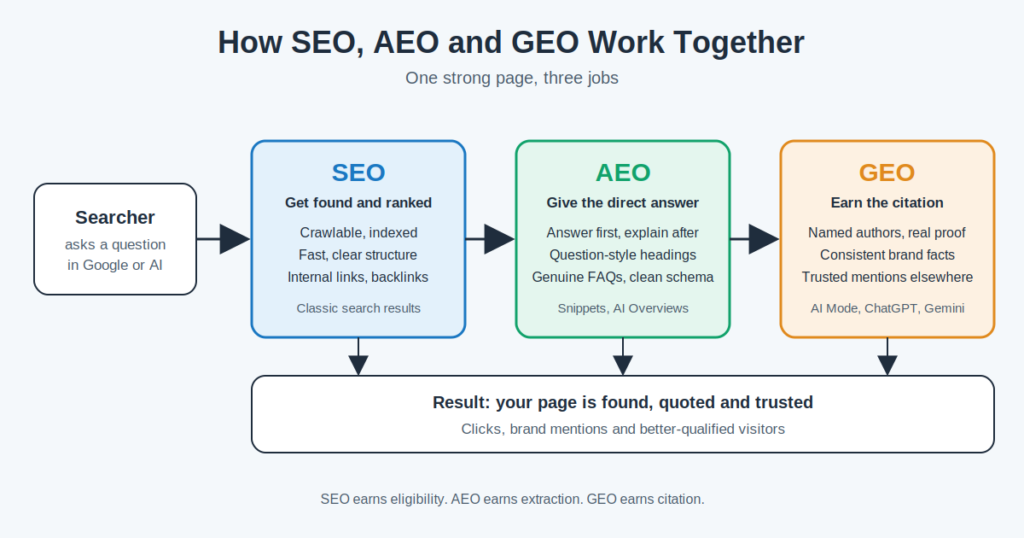
You do not need three separate pages. You need one strong page that does three jobs.
Step 1: Start with the real question behind the keyword
Write down who is searching, what they already know and what they need to decide. A page that matches search intent is the base for every layer.
Step 2: Answer first, explain second
Put a two or three sentence answer directly under each question heading. Then add examples, steps and context. This helps both featured snippets and AI answers.
Step 3: Cover the subtopics
Use related terms naturally, such as entities, structured data, search intent, Search Console and citations, so the page answers the follow-up questions a fan-out search would ask. Do not stuff them in. Write for the reader.
Step 4: Show real experience and authorship
Add an author name, credentials, first-hand examples and original numbers. Google’s guidance on creating helpful, reliable, people-first content is a good self-check for this.
Step 5: Add accurate structured data and a genuine FAQ
Schema helps machines read your page, but only when it matches what is visible. Write FAQs from questions customers actually ask, not filler.
A Real Example From Our Own Site
We saw this shift on our own data. One of our blog queries about Google Business Profile posts lost about 92 percent of its impressions after an AI Overview began answering it in full. The overview cited several other sources, and our page was not among them. Rankings had not collapsed. The answer had simply moved above the results.
That single case changed how we write. We now lead with direct answers, add clearer definitions and include original detail that a generic summary cannot copy. It is a small example, but it shows why a ranking report alone no longer tells the full story.
How to Measure AI Search Visibility
Measurement is still imperfect, so combine a few signals.
- Watch impressions, clicks and click-through rate together in Search Console. Falling clicks with steady impressions can point to an on-page answer.
- Review the Google AI Overviews report in Search Console. Our guide to the AI Overviews report in Search Console explains how to read it.
- Test your key questions manually in Google, ChatGPT and Gemini every month, and note whether your brand is cited.
- Track branded search growth, since AI mentions often show up as people searching your name later.
Common Mistakes to Avoid
- Building separate AEO and GEO pages that repeat the same content, which risks duplication.
- Chasing new acronyms while ignoring technical SEO basics.
- Publishing bulk AI-written content with no original insight or named author.
- Marking up FAQ schema for questions that are not on the page.
Frequently Asked Questions
Is AEO or GEO replacing SEO?
No. SEO remains the foundation, and Google says its best practices still apply to AI features. AEO and GEO extend SEO rather than replace it.
What is the difference between AEO and GEO?
AEO focuses on giving a direct, extractable answer to a specific question. GEO focuses on becoming a trusted source that generative systems cite.
Do I need special schema to appear in AI Overviews?
No special markup is required. Accurate structured data helps machines understand your page, but it does not guarantee inclusion.
How long does it take to see results?
It varies by site and competition. Content improvements often take weeks to be recrawled and reassessed, so review progress over a few months rather than a few days.
Where to Start
Begin with your five most important pages. Check that each answers a clear question, shows real authorship and loads without technical problems. At Techbound, we help businesses build this foundation through our SEO and AI search services, and you can also see our broader SEO services in Kerala.