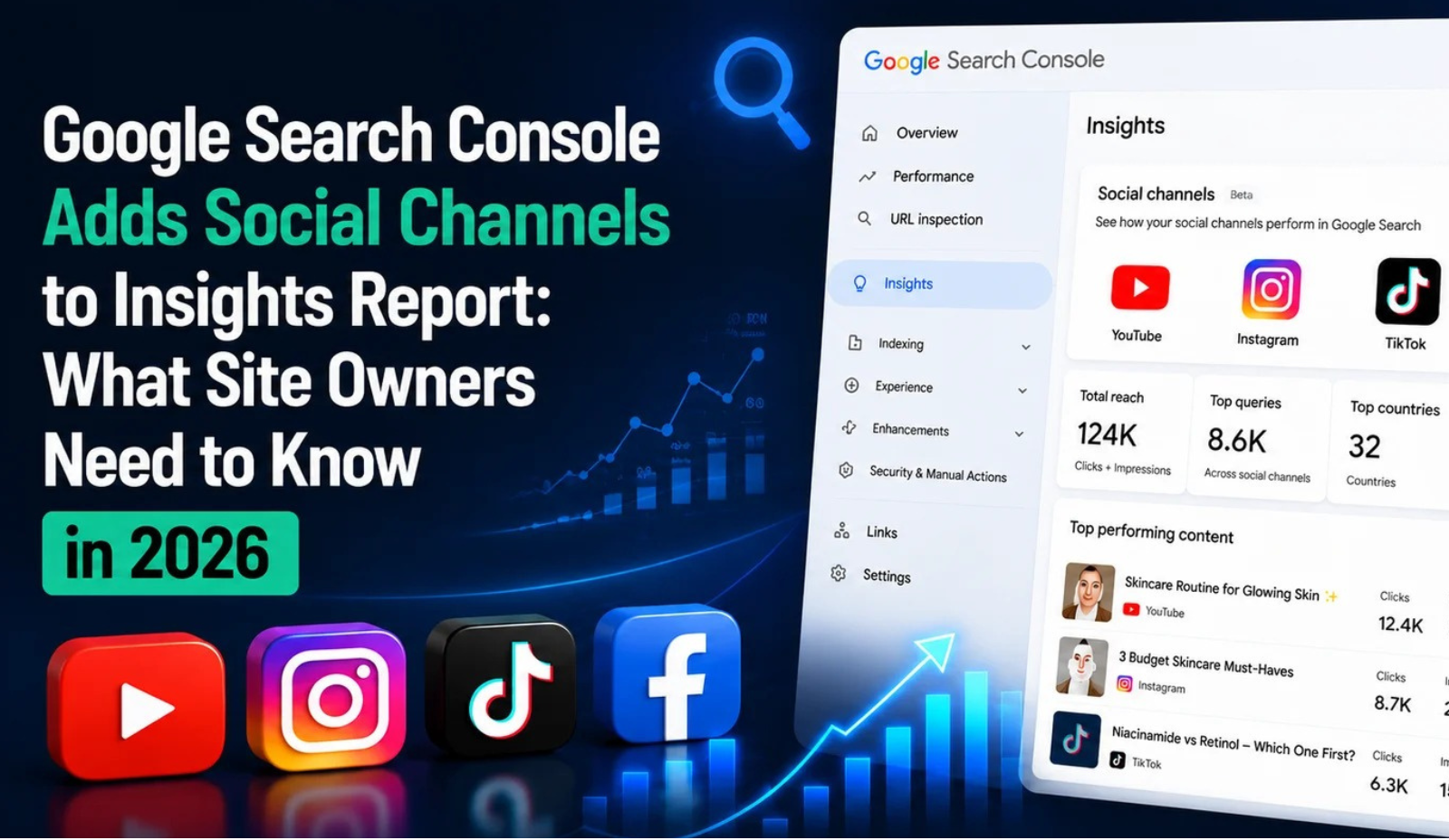
On December 8, 2025, Google officially rolled out one of the most talked-about updates to Search Console in recent memory: social channel data inside the Insights report. For the first time, site owners can see how their YouTube, Instagram, TikTok, and Facebook profiles perform in Google Search right next to their website’s organic metrics, in one unified dashboard built for social search integration.
If you manage SEO for a brand, a creator page, or a small business, this update changes how you should think about “search visibility” and brand discovery. It’s no longer just about your domain, it’s about your entire digital footprint.
This guide breaks down what the feature actually does, how to check if you have access, and how to use it without falling into duplicate-content or over-optimization traps that Google’s spam systems are increasingly good at catching.
What Is the New Social Channels Feature?
Search Console’s Insights report has traditionally focused on a single property: your website. With this experimental update, Google now pulls in performance data for social profiles it has automatically identified and associated with your verified site.
In its official announcement on the Google Search Central Blog, Google explained that the update is meant to reflect how modern brands actually operate spread across a website and several social platforms and that combining this data “will give site owners a better understanding of their combined performance” across surfaces.
Importantly, this is still labeled an experiment. It is currently visible only to a limited set of properties where Google’s matching system has confidently linked a social profile to a website. You cannot yet manually add or request a channel if it has to be auto-detected.
Key Features of the Update
The new Insights cards show several data points for each connected channel:
- Total reach combined clicks and impressions driving traffic from Google Search to your social profile.
- Content performance: your top-performing social posts or videos, plus which ones are trending up or down.
- Search queries the actual terms people typed that led them to your social page, including trending queries.
- Audience location: the top countries generating clicks on your social content through Search.
- Additional traffic sources a related card showing clicks from Image Search, Video Search, News Search, and Discover.
Google currently supports channels like YouTube, Instagram, TikTok, and Facebook, though it hasn’t published the exact criteria it uses to detect and match a profile to a domain. Together, these data points form the backbone of what’s essentially a multi-channel marketing view, tying your search performance metrics to platforms Search Console never used to touch.
How to Check Eligibility and Set It Up
Since this is a phased experiment, most site owners won’t see it yet. Here’s how to check:
- Log into the Search Console and open the Insights tab for your property.
- Look for a prompt asking you to confirm or add detected social channels. This only appears if Google has already matched a profile to your site.
- If you see it, click through to link the channel. If you don’t, your property simply hasn’t been included in the current test batch; there’s no manual opt-in yet.
- Keep your social bios, website links, and brand naming consistent across platforms. Google’s matching logic appears to rely heavily on cross-referencing profile URLs and brand metadata, so mismatched handles or outdated bio links may prevent detection.
Because Search Console’s Insights and Performance reports already run on a data delay, expect social channel numbers to lag by a few days as well.
Why This Matters for SEO in 2026
This update lands at an interesting moment. Google’s ranking systems have moved well beyond simple keyword matching for years now; BERT introduced deeper contextual language understanding back in 2019, and MUM extended that into multimodal, multi-step query understanding across text, images, and video. Both systems reflect a broader shift: Google increasingly evaluates content and intent holistically, not just isolated web pages.
Bringing social performance into Search Console is a natural extension of that philosophy. It signals that Google treats a brand’s YouTube video, Instagram carousel, or TikTok clip as part of the same discovery ecosystem as its website, all subject to the same core relevance and quality signals that shape organic vs. social performance across the board.
That also means the same caution applies. With Google’s spam and core updates through 2025 and into 2026 continuing to target thin, templated, and AI-generated filler content, simply pumping out repetitive posts across channels to “game” this new visibility won’t help. Google’s systems are explicitly designed to reward original, experience-backed, genuinely useful content the same E-E-A-T (Experience, Expertise, Authoritativeness, Trustworthiness) principles that apply to web pages now effectively extend to how your social presence is evaluated in search context.
Best Practices for Using This Data
- Compare, don’t duplicate. Use trending social queries to spot content gaps on your website, but write fresh, original coverage don’t just republish social captions as blog posts.
- Prioritize real experience. Posts and articles that reflect hands-on testing, first-hand results, or original data tend to hold up better under both social and search scrutiny.
- Treat channels as one ecosystem. If a query is driving traffic to your Instagram post but you have no matching website page, that’s a genuine content opportunity not just a vanity metric.
- Keep profiles consistent. Accurate, matching brand information across your website and social bios improves the odds Google’s matching system links your channels correctly.
- Watch for the prompt, don’t force it. There’s currently no way to manually request inclusion to focus on strengthening genuine cross-channel consistency instead of chasing early access.
How This Shows Up for Real Brands
Say you run a mid-sized skincare brand with a website and an active YouTube channel where you post ingredient breakdowns and routine videos. Before this update, tracking your social media search visibility meant checking Search Console for your website’s organic traffic, then separately logging into YouTube Studio to see how your videos were doing in search of two dashboards, two data sets, and no easy way to connect them into one unified analytics view.
With social channels now showing up in Insights, you might notice something like this: a video titled “Niacinamide vs. Retinol Which One First?” is pulling in steady clicks from Google Search for the query “niacinamide retinol order,” but your website has no blog post covering that exact question. That’s a visible content gap one you’d have had to dig for manually before, comparing spreadsheets across two tools. Now it shows up as a single insight card, pointing you straight to a real opportunity for cross-channel SEO: write the blog post, and maybe link it from the video description too, tightening the loop between your YouTube SEO and your on-site content.
That’s really the practical value here. It’s not flashy, it just removes a step that used to take extra tools and guesswork.
Here’s a different kind of case: a solo creator running a food-recipe TikTok account alongside a small recipe blog. Their TikTok clip “5-Minute Garlic Butter Noodles” keeps showing up for searches like “quick garlic noodles recipe,” and the Insights card flags it as trending upward for that exact query, a clear sign of strong off-site content performance. Their blog, meanwhile, has a similar recipe but under a different title that doesn’t match how people are actually searching. That mismatch invisible before is now something they can act on directly: retitle the blog post to better match search intent, or add the TikTok query phrase into the post’s intro, instead of guessing what to optimize for.
So, is this feature available to everyone right now? Not yet it’s still an early-stage experiment limited to properties where Google has automatically matched a social profile to a site. There’s no manual request option, so you can’t apply for early access even if you want to. As for which platforms are covered, YouTube, Instagram, TikTok, and Facebook have all been spotted so far, though Google hasn’t published a fixed, official list; more channels could be added as the test expands. And no, this isn’t a new ranking factor in itself; it’s a reporting layer. What it does reflect, though, is Google’s broader shift toward evaluating content quality and relevance across your whole online presence, not just your domain.
Conclusion
This update is a small but telling signal of where search is headed. Google isn’t just indexing your website anymore, it’s paying attention to how your brand shows up everywhere, from a YouTube video to an Instagram Reel, and treating that as part of the same discovery story your domain is part of.
For now, there’s nothing to “set up” beyond watching for the prompt in your Insights report and keeping your social profiles consistent with your website. But it’s worth paying attention to, because it’s an early look at how Google plans to measure and eventually reward brands that show up consistently and usefully across the web, not just on one page at a time.
If you haven’t seen the prompt yet, you’re not missing a step you forgot to take. You’re just not in the test group yet and that’s completely out of your hands for now.
Digital marketing never stands still, and updates like this are a good example of that. Staying informed on these changes, and knowing how to apply them, is what helps a business grow online. That’s the kind of support Techbound offers — helping brands keep up with the latest in digital marketing and grow their digital presence, step by step.