

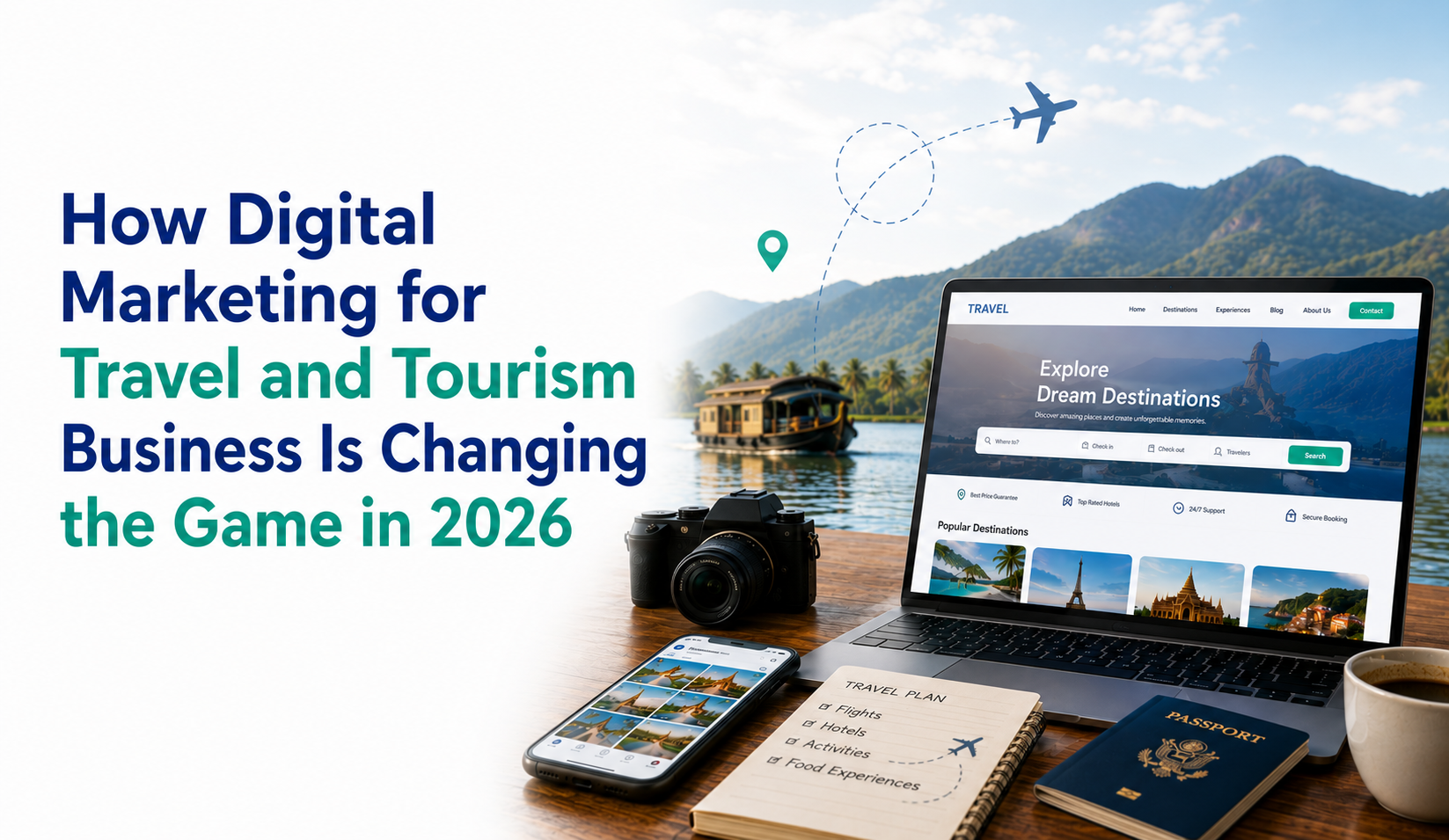
Nobody books a holiday the way they used to. Ten years ago, you’d walk into a travel agency, flip through a brochure, and trust whatever the agent behind the counter told you. Now, the whole thing happens on a phone screen, usually somewhere between scrolling Instagram and checking work email. A traveler sees a reel of a houseboat gliding through Alappuzha’s backwaters, googles it an hour later, reads a few reviews, and books it before dinner. That’s the entire customer journey now, and it’s exactly why digital marketing for travel and tourism business has stopped being optional. In 2026, it’s simply how the industry works.
And the demand backing this up is real. An estimated 1.52 billion people traveled internationally in 2025, the highest number ever recorded in the post-pandemic era, and UN Tourism expects that momentum to carry into 2026. Closer to home, Kerala had its own record year too, welcoming 25.88 million visitors in 2025. Domestic tourists alone crossed 2.5 crore, up 12.46% from the year before, while foreign arrivals grew 11.3% to touch around 8.2 lakh. So whether someone’s planning a weekend in Wayanad or a two-week trip through Europe, the pattern looks the same: they’re discovering, comparing, and booking online, and the businesses showing up in that search are the ones getting the bookings.
Why Travel Marketing Doesn't Work Like Everything Else
Here’s the thing about selling travel: you’re not selling a product, you’re selling a feeling. Nobody wakes up wanting “a hotel room.” They want to picture themselves on a balcony overlooking tea plantations, or trying street food in a city they’ve never visited. That’s a very different sell than, say, a pair of shoes, and it means visual storytelling and trust matter more here than almost anywhere else in marketing.
It also means people take their time. International trips especially involve visas, flights, longer itineraries, bigger budgets, so nobody’s booking on impulse. They’re comparing five tabs at once, reading reviews at 11pm, coming back to the same website three or four times before finally hitting “confirm.” A travel business needs to be visible at every one of those touchpoints, not just the final one.
What Actually Moves the Needle for Travel Businesses
1. SEO Built Around How Travelers Actually Search
When someone types “best homestays near Munnar” or “customized Europe packages from India,” whether you show up on page one or page three of Google decides whether they even know you exist. Good SEO means optimizing destination pages and blog content around the exact phrases travelers use, keeping the site fast and easy to navigate on mobile, and doing this for both local and outbound travel searches. It matters even more in destinations that are suddenly having a moment. Wayanad pulled in over 13 lakh visitors in a single year, and the businesses there that already had solid local SEO in place were ready for that surge instead of scrambling once it hit. Content written from real, on-the-ground knowledge of a place tends to rank better anyway, since it’s exactly the kind of firsthand experience search engines look for when deciding which pages deserve to rank.
2. Content That Earns Trust Before the Phone Even Rings
A good blog post does more work than people give it credit for. Something like “A Complete Guide to Backwater Tourism in Alappuzha and Kumarakom” or “How to Plan a Budget Europe Trip from India” isn’t just there to pull in search traffic, it quietly builds the impression that this business actually knows what it’s talking about. That impression usually comes from a well-thought-out content strategy, often shaped with help from a digital marketing agency that understands what travelers are actually looking for. Real testimonials, honest traveler stories, a clear “we’ve been doing this since 20XX” somewhere on the site, all of it adds up to the kind of trust travelers look for before they commit.
3. A Google Business Profile That's Actually Kept Up
For homestays, small hotels, and local tour operators, your Google Business Profile is often the very first impression someone gets of you, sometimes before they even open your website. Fresh photos, correct contact details, and regular updates all help you show up when someone nearby is searching. For agencies that also arrange international packages, this is often the small trust signal that tips someone toward booking with you instead of a competitor at a similar price.
4. Social Media That Sells the Feeling, Not the Feature
Travel content is made for platforms like Instagram. A reel of sunrise over a Munnar tea estate, or a candlelit dinner on a houseboat, does more to make someone want to travel than any ad copy ever could. It works the same way for international destinations too, snow falling on a European street corner sells the trip before the traveler has even opened a booking site.
5. Reviews: The Currency Nobody Can Skip
According to a review-impact study by Hotelagio, 95% of travelers read reviews before booking, and 93% say those reviews actually shape their decision. That number doesn’t change much whether someone’s booking a homestay in Kerala or a hotel in another country. Actively collecting reviews, and actually replying to them, is one of the highest-return activities a travel business can put time into.
6. Retargeting, for the Ones Who Almost Booked
Most travelers don’t book on the first visit. They browse, they compare, they leave the tab open and forget about it. This is even truer for international trips, where the stakes and the price tags are higher. Retargeting ads are what bring that person back at exactly the point they’re ready to commit.
What This Looks Like in Practice
Put all of this together and the goal shifts from “get more traffic” to “get the right traffic.” That’s already visible across Kerala, where districts like Wayanad, Kozhikode, and Thrissur, once considered lower-footfall areas, are now seeing real growth, giving the whole Malabar region a boost. Meanwhile, international arrivals keep climbing toward record highs globally. When SEO, content, social, and reviews are all pulling in the same direction, what you get is a steady flow of people who were already planning to travel, not random clicks that go nowhere.
Frequently Asked Questions
Why is digital marketing important for travel and tourism businesses in 2026?
Because nearly every traveler now researches and books online before ever contacting a business directly. Without visibility on search engines, social media, and Google Business Profile, a travel business simply doesn’t get considered, no matter how good the actual experience is.
Does digital marketing work the same way for domestic and international travel businesses?
The core principles, SEO, content, reviews, social proof, apply to both. The difference is mostly in decision timelines. International travelers usually research longer and compare more options, so retargeting and detailed content matter even more for outbound travel businesses.
What’s the fastest way for a small travel business to improve online visibility?
Start with Google Business Profile, since it’s free and often the first thing people see. Pair that with consistent, original blog content around the destinations you specialize in, and make sure you’re actively collecting and responding to reviews.
How long does it take to see results from SEO in the travel industry?
Typically three to six months for noticeable ranking improvements, though this varies based on competition in the destination and how much original content the business is willing to invest in consistently.
Conclusion
Travel marketing runs on inspiration, trust, and timing, whether it’s a weekend getaway or a trip halfway across the world. Digital marketing ties these three things together in a way a brochure or a billboard simply can’t. With Kerala’s tourism numbers and global international arrivals both climbing in 2026, the businesses that invest in genuine, original digital strategy now are the ones that’ll actually turn all this traveler interest into real bookings.