
- May 21, 2026
- by Kishore
Why Brand Authority Matters More Than Keywords in AI Search
Keywords are no longer the main thing that drives search. Trust and brand authority shape it now, especially in AI search.
SEO used to be easy. Choose the right keywords, get to the top of the search results, and keep track of clicks. Traffic came if you ranked well. People would look through a lot of results before choosing where to go.
But AI search has changed that. Google’s AI Overviews, ChatGPT-style search, and Perplexity are examples of tools that don’t just show links anymore. They get information from many places and give one answer. Users don’t even click through to websites a lot of the time.
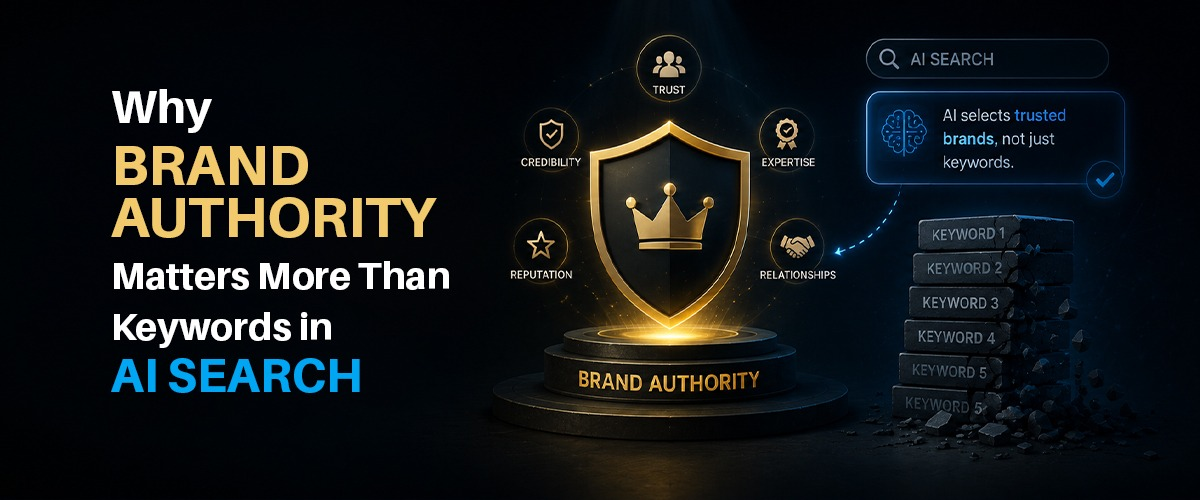
This changes SEO in and of itself. It’s not just about getting a high rank for keywords anymore. It’s about being trusted enough to be part of the answers made by AI. Brand authority in AI search is now more important than regular optimization.
How AI Search Is Changing SEO: From Pages to Entities
Traditional SEO was mostly about getting web pages to rank through keywords and backlinks. You’d optimise a page, build links, and try to climb the search results.
AI search works differently. It focuses more on entities, meaning real brands, organisations, and sources it can trust enough to include directly in its answer.
So instead of showing users a long list of websites, AI systems now pick a few brands and weave them into a single response. People are no longer comparing ten blue links. They’re reading one answer where only a handful of names get mentioned.
Because of that, keyword SEO alone doesn’t carry the same weight anymore. It still helps with relevance, but what really shapes visibility in AI search is how strong and credible the brand appears to the system.
AI Search Ranking Factors: What Builds Brand Authority
AI-driven search doesn’t rely on one “ranking factor” the way traditional SEO used to. It looks at the broader pattern instead. In simple terms, it tries to figure out whether a brand feels consistently trusted across the internet.
So it doesn’t just ask, “Does this page rank well?” It asks, “Does this brand show up as credible everywhere it appears?”
The signals it picks up from include things like:
- Whether people are actually searching for the brand by name
- The quality and variety of websites linking back to it
- Mentions in articles, media coverage, and industry discussions
- Customer reviews and overall sentiment
- How clearly the content is structured and understood by machines
- E-E-A-T signals, meaning experience, expertise, authority, and trust
But the real deciding factor is how all of this fits together. When these signals reinforce each other, the brand starts to look stable and trustworthy in the system’s eyes. When they don’t line up, visibility tends to drop, even if the website itself is well-optimized.
That’s also why two brands targeting the same keywords can end up with very different results in AI search.
Why Brand Authority in SEO Matters More for SMBs
This change affects small and mid-sized businesses (SMBs) more than large brands. In traditional SEO, SMBs could compete well. Good keyword targeting and solid content often meant good rankings.
AI search works differently. It relies more on external trust signals, and larger brands already have those through:
- Media coverage
- Strong backlinks
- Higher branded searches
- Long-term reputation
This makes AI search harder for SMBs. Even strong content may not show up in AI answers if the system lacks authority signals around the brand.
Still, SMBs can compete by focusing on niche authority instead of trying to match big-brand scale.
Zero-Click Search and the Rise of AI-Generated Answers
AI search has made zero-click behavior much more common. People often get their answers right on the results page and move on without visiting any website.
That does cut into traditional website traffic, but it also changes what “visibility” really means. The real win now is getting your brand mentioned inside the answer itself.
When people keep seeing a brand show up in those AI responses, it starts to feel familiar, even if they are not actively looking for it. That familiarity usually shows up later as branded searches, more trust, and better conversions when they finally land on the site.
There is also a snowball effect here. The more often a brand appears in AI answers, the more likely it is to keep appearing again. Over time, that repeated presence quietly builds authority.
Why Keywords Are No Longer Enough in Modern SEO
Keywords still matter in SEO, but not in the way they used to. They now act more like signals that help search systems understand relevance, rather than something that can directly drive rankings on their own.
Modern search doesn’t just ask, “Is this relevant?” It also asks, “Can this source be trusted?” And that trust is built less from what’s on the page and more from what the wider web says about the brand.
That’s why a page can be perfectly optimized for a keyword and still not show up in AI-driven search results if the brand doesn’t have enough authority outside its own site. You see this often in crowded industries where everyone is publishing similar content and saying the same things.
For small and mid-sized businesses, this creates a clear gap in AI SEO strategy. Content helps you get into the conversation, but without external credibility, it often isn’t enough to stay visible.
How to Build Brand Authority for AI Search Visibility
Brand authority in AI search doesn’t really come from one strong signal. It builds over time when everything around a brand feels consistent, credible, and recognizably the same.
What tends to matter most looks like this:
- Content that actually shows expertise and a clear point of view
- Mentions in trusted publications or credible industry spaces
- Strong reviews and a solid reputation across platforms where people talk about the brand
- A steady, consistent way the brand presents itself everywhere it appears
- Clear structured data so systems can easily understand what the brand is and does
Content still plays a role, but only when it reflects real experience or knowledge. By itself, it rarely carries enough weight. It becomes meaningful when other sources outside the brand reinforce it.
Consistency ties everything together. If a brand looks slightly different across platforms or sends mixed signals, AI systems struggle to confidently treat it as one clear entity. And that weakens authority, even if the individual parts are strong.
AI SEO Strategy: Combining Authority and Generative Optimization
Modern AI SEO really comes down to two layers that work together.
First is brand authority. In simple terms, it’s whether the system trusts your brand enough to even consider it for an AI-generated answer.
Second is Generative Engine Optimization (GEO). This is about how well your content is structured so AI systems can actually read it, understand it, and pull it into responses.
You need both if you want to show up consistently in AI search. Authority gets you into the “maybe we can use this” pool. Structure decides whether your content is actually usable.
If authority is missing, you don’t get considered at all. If the structure is weak, you get overlooked even if your content is good.
When both are in place, visibility in AI search becomes much more stable and easier to scale over time.
Final Thoughts: The Future of SEO in AI Search
SEO is no longer just about keywords. It has moved into a trust-driven space where AI search engines pick brands based on how credible and consistent they look across the web.
This doesn’t reduce SEO’s importance. It simply expands it. SEO now blends into content, branding, reputation, and overall visibility across platforms.
For SMBs, this shift is significant. Keywords alone won’t guarantee visibility in AI search. Without external authority, even well-optimized pages can get ignored. But the playing field isn’t closed. Strong niche authority can still help smaller brands compete with much larger ones.
At this stage, SEO, content, and brand presence can’t really sit in separate silos anymore. They need to work together. That’s where a reliable digital partner helps, not as a shortcut, but to bring all these pieces into one clear, focused direction.
Because in AI search, keywords might get you seen, but authority decides whether you get picked, quoted, and remembered.
