
- April 27, 2026
- by Kishore
Google’s AI Overviews Stole Your Clicks. Now What?
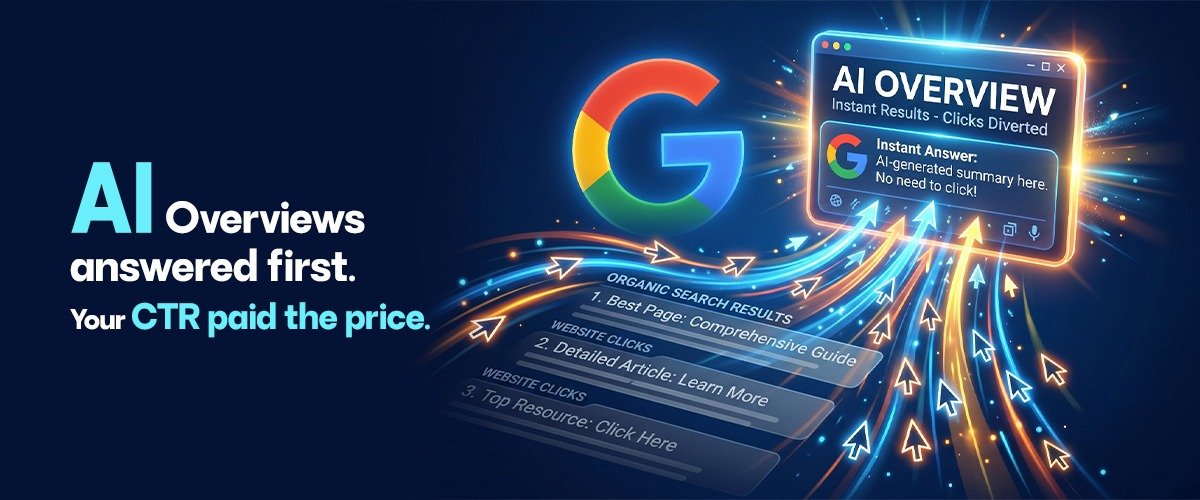
Congratulations. You rank on page one. Your content is good. Your technical SEO is spotless. And yet somehow, bafflingly, your traffic is down. Welcome to 2026, where Google has placed a very confident robot between you and your audience, and the robot answers questions for free.
That robot is called an AI Overview (AIO). And according to the most comprehensive study on the subject, Seer Interactive’s 14-month analysis of 5.47 million queries across 53 brands, it’s rewriting the rules of search, fast.
But here’s the thing: the data is more nuanced than the chaotic headlines. And if you understand what’s actually happening, you can stop losing and start adapting.
The Numbers, Honestly
Let’s start with the crucial part.
Organic CTR on AI Overview queries dropped 61% at peak. The floor hit 1.3% in December 2025, the worst point in 14 months of tracking. By February 2026, it bounced back to 2.4%, an 85% climb from that low. Meanwhile, 48% of all Google searches now trigger an AI Overview, up from virtually nothing two years ago.
Yes, CTR fell off a cliff through most of 2025. No, it didn’t keep falling forever. The Seer data shows something unexpected happened in early 2026 where organic CTR bounced back meaningfully from its December floor. That’s not a full recovery, but it’s not a death spiral either.
The smarter story though isn’t in the averages. It’s in where the clicks went.
What actually happened in Q4 2024 was largely a math story. Google served AI Overviews to exponentially more queries, impressions exploded, and click counts stayed roughly flat. When impressions double and clicks hold steady, your CTR looks like it fell off a cliff, even though nothing actually got worse for you. Many site owners panicked at a dashboard that looked red, when their actual audience reach hadn’t changed.
That said, November 2025 told a different story. Impressions kept growing but clicks actually dropped. The AI Overview had become good enough to end the session on its own. That’s the real problem, and pretending otherwise would be dishonest.
Not All Queries Are Equal
AI Overviews don’t appear equally across all search types. Comparison queries trigger them 95% of the time. Question-format queries, 86%. But transactional queries like “buy,” “near me,” “price,” and “order” trigger AI Overviews only about 5% of the time.
If your business depends on people finding you at the moment of purchase, your exposure to AIO-driven CTR collapse is significantly lower than the headline numbers suggest. Informational and educational content bears the heaviest burden. If your strategy leaned heavily on top-of-funnel, how-to, and explainer content, that’s where you’re bleeding most.
Meanwhile, queries without AI Overviews became more valuable. CTR on those queries rose from 2.8% in early 2025 to 3.8% by February 2026. The people who still click through are searchers who want depth, and they’re clicking more than ever.
For SEO Professionals: How Do I Recover?
Stop optimizing to reclaim the old game. The new game is citation, getting your content referenced inside the AI Overview box, not just below it. Seer’s data is unambiguous: brands cited within AI Overviews earned 35% more organic clicks and 91% more paid clicks compared to uncited brands on the same SERP. Being cited is the new Position Zero.
What earns citations? Content that directly answers user intent, clearly, quickly, and authoritatively. Start every key article with a 50 to 70 word direct answer to the primary query. Use structured data. Build genuine topical authority, not just keyword density. Think less “rank for this term” and more “become the source Google trusts enough to quote.”
Audit your query portfolio. Shift emphasis toward transactional and commercial-intent queries where AI Overviews appear infrequently. Track your share of voice in AI responses, not just your ranking position. And critically, re-evaluate your KPIs. Your team may be doing everything right and still showing lower CTR, because the metric they’re being measured on is no longer fully in their control.
Finally, diversify off Google. Email, AI platforms like ChatGPT and Perplexity, and social search are capturing users who used to arrive through organic search. This isn’t defeatism. It’s portfolio management.
The Key Takeaway
Google made more money last year than ever before. Your CTR dropped 61%. These two facts coexist comfortably for Google and uncomfortably for you. AI Overviews are the mechanism. Adaptation is the only sensible response.
The Seer data gives you a clear map of what works. Brands cited inside AI Overviews earn 35% more organic clicks and 91% more paid clicks than uncited brands sitting right below them on the same page. The gap between cited and uncited is now larger than the gap between page one and page two ever was.
So here is your practical priority list. Check your Search Console for queries where impressions are rising but clicks are falling. Those are your AIO-hit pages and your first targets for restructuring. Rewrite them to answer the primary question in the first paragraph, directly and completely. Add structured data. Build the kind of authority that makes Google want to quote you rather than paraphrase you.
Then stop waiting for the old traffic model to return. The users reaching you today are fewer, more serious, and more ready to act. The brands that figure that out now will be very difficult to displace six months from now.
