


Elon Musk, never one to shy away from shaking things up, has unleashed XChat, a new messaging feature on the X platform (formerly Twitter).
Announced in June 2025, XChat promises end-to-end encryption, vanishing messages, unrestricted file sharing, and audio/video calls without needing a phone number.
But in a country where “WhatsApp karo” has replaced “text me,” can XChat make a breakthrough? This article dives into XChat’s features, vulnerabilities, and its potential impact in India’s multilingual, multicultural landscape, with a hint of sarcasm for Musk’s over the top promises.
What is XChat?
XChat is a revamped direct messaging (DM) feature integrated into X, built from scratch using the Rust programming language, known for its speed and memory safety.
It’s designed to compete with WhatsApp by offering:
- End-to-End Encryption
Claimed to be “Bitcoin-style,” though experts question its validity.
- Vanishing Messages
Messages that auto-delete for added privacy.
- File Sharing
Supports any file type, unlike WhatsApp’s 2GB limit.
- Audio/Video Calls
Cross-platform calls without a phone number.
- X Integration
Uses X handles for identification, tying it to the X ecosystem.
Musk’s vision is to transform X into an “everything app” like WeChat, combining messaging, social media, and potentially payments.
But with WhatsApp’s 500 million+ Indian users, XChat has a mountain to climb.
First Mention and Rollout
Rumors of XChat surfaced in January 2025, with reports mentioning Musk’s plans to overhaul X’s DMs.
The official announcement came in June 2025, with Musk confirming its rollout via an X post.
As of June 6, 2025, XChat is in beta testing, available to select X Premium subscribers, with a full rollout to all users expected this week, barring scaling issues.
Whether free users will get limited access remains unclear, but premium features might be paywalled.
Xchat V/S WhatsApp
XChat and WhatsApp share similarities but differ in key areas. Below is a detailed comparison:
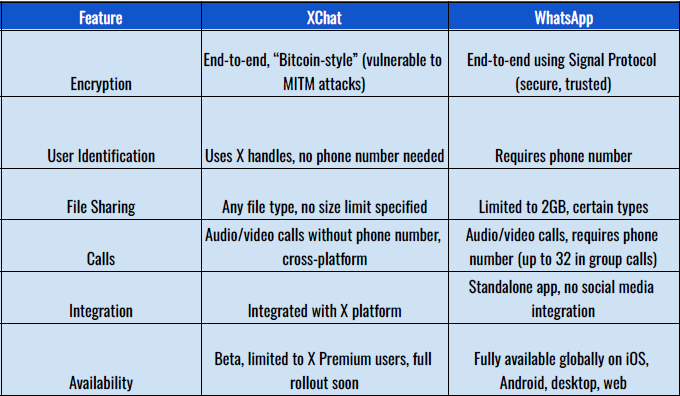
Pros of XChat
1. No Phone Number Required
XChat’s use of X handles eliminates the need for a phone number, a boon for privacy-conscious users.
A startup founder in Bangalore can pitch to investors using their X handle, keeping their number private.
A Mumbai student can chat with friends as @anonymous123 without sharing personal details.
This simplifies signup and aligns with India’s growing privacy concerns. It’s a refreshing change from WhatsApp’s insistence on phone numbers.
2. Large File Sharing
XChat supports unrestricted file types, unlike WhatsApp’s 2GB limit.
A Chennai graphic designer can send a 5GB video ad to clients without compression hassles.
A student in Hyderabad can share a hefty research paper with classmates.
This flexibility is a game-changer for businesses and students handling large files.
3. Add Your Heading Text Here
XChat’s seamless integration with X’s social features is a plus for businesses and influencers.
A Kerala brand can share a promotional post directly in XChat, engaging customers instantly.
A foreigner user can discuss a viral X post privately with friends. This makes XChat a one-stop shop for social and messaging needs.
It’s a clever move to leverage X’s existing user base.
4. Enhanced Privacy Features
Vanishing messages and (alleged) end-to-end encryption appeal to privacy buffs.
A lawyer can discuss sensitive case details that auto-delete after reading.
A user can share personal gossip, confident it won’t pop up.
If XChat’s encryption holds up, this could be a strong selling point. For now, it’s a promising feature with a big “if.”
5. Cross-Platform Calls
Audio and video calls without phone numbers are convenient, especially for remote teams.
A remote village startup can hold team meetings via XChat without sharing numbers.
Friends in villages can video call using X handles, avoiding WhatsApp’s phone number requirement.
This feature caters to India’s tech-savvy, privacy-conscious crowd.
Cons of XChat
1. Security Concerns
Musk’s “Bitcoin-style encryption” claim has raised eyebrows, as Bitcoin’s blockchain is public, not encrypted.
Experts warn of man-in-the-middle attacks, where messages could be intercepted.
A Bank might avoid XChat for financial discussions due to these risks. A user might worry their private chats aren’t secure.
This is a major red flag in a country obsessed with data privacy.
2. Limited Availability
XChat is currently limited to X Premium subscribers, restricting its reach.
A basic user might not afford the subscription, unlike WhatsApp’s free access.
An user without X Premium is left out.
This exclusivity could alienate India’s cost-conscious users. WhatsApp’s universal access wins hands-down here.
3. Dependence on X Platform
Requiring an X account is a hurdle for non-X users.
A company with employees not on X might find it inconvenient for internal chats.
A user who prefers social media platforms might not want an X account just for messaging.
In India, where WhatsApp is a standalone giant, this dependency is a drawback. It’s like asking someone to join a new club to send a text.
4. Premium Features Locked
Advanced features like group calls or emojis might be paywalled.
A freelancer might need to pay for X Premium to access these, adding costs.
A user might miss out on file sharing without a subscription.
This pay-to-play model contrasts with WhatsApp’s free features.
5. Unproven Track Record
As a new platform, XChat lacks WhatsApp’s reliability.
A corporate executive might stick with WhatsApp for critical deals due to its proven track record.
A user might prefer WhatsApp’s glitch-free experience.
In India, where trust in tech is hard-earned, XChat’s newness is a risk.
It’s like betting on a new restaurant when your local food stall never fails.
Probable Impact in India
India is WhatsApp’s fortress, with over 500 million users who rely on it for everything from family chats to business deals, especially post-COVID.
The phrase “WhatsApp karo” is as Indian as chai and cricket.
XChat’s no-phone-number feature might attract privacy-conscious users, like techies or students. Businesses, especially influencers and brands on X, might use it for customer engagement, like a boutique sharing promotions via XChat.
However, security concerns and the X account requirement could slow adoption.
In a multilingual, multicultural country, XChat’s interface might need localization to compete with WhatsApp’s Hindi, Tamil, and other language support.
It may take years to become a viable alternative, likely starting as a secondary app for X users.
The Takeaway
XChat is Musk’s bold attempt to challenge WhatsApp, but it’s not ready to steal the crown in India.
It’s no-phone-number signup and X integration are innovative, but security flaws, limited availability, and platform dependency are major hurdles.
For Indian businesses, XChat could be a niche tool for social media-driven communication, but WhatsApp’s reliability and free access keep it unbeatable.
For the common person, it’s hard to imagine swapping “WhatsApp karo” for “XChat karo” anytime soon. Maybe Musk will fix the bugs and prove us wrong, but for now, WhatsApp remains the boss of Indian messaging.